
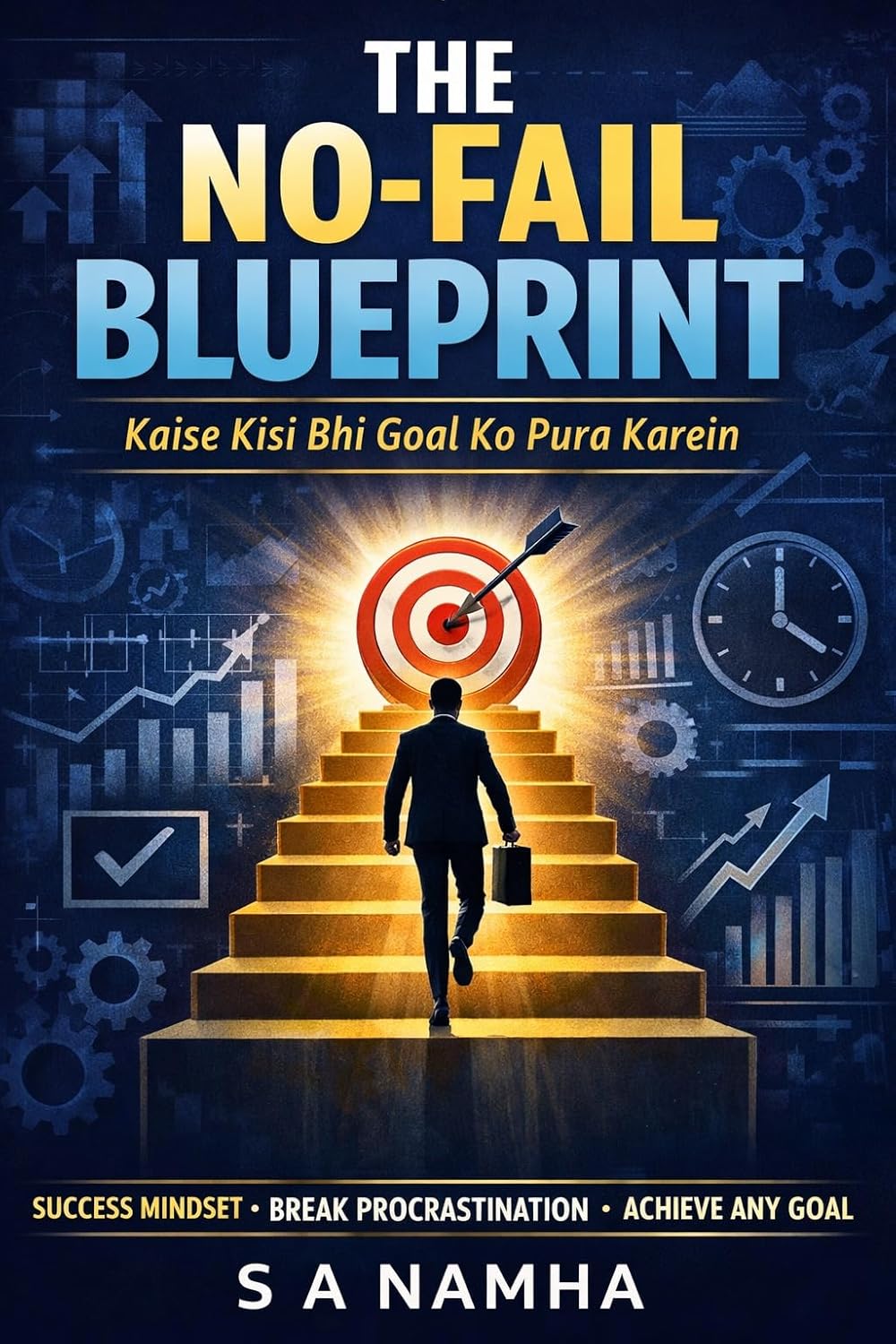
The No-Fail Blueprint-English Edition-How to Accomplish Any Goal
Disclaimer
With a completely unique idea, we are making it with the aim of motivating people. “All the characters and incidents of the story used in it are imaginary, it has no connection with any person or event. If there is any similarity with any person, then it will be called a mere coincidence.” This E-Book Story is only for Motivation, we do not want to hurt the sentiments of any religion or community.
Copyright © 2026 Namha
All rights reserved.
No part of this book may be reproduced, stored, transmitted, or shared
in any form or by any means—electronic, mechanical, photocopying,
recording, or otherwise—without prior written permission of the author,
except for brief quotations in reviews.
This is a work of fiction. Names, characters, places, and incidents
are either the product of the author’s imagination or used fictitiously.
Any resemblance to actual persons, living or dead, is purely coincidental.
First Edition: 2026
Published by: Namha Innovatives
✍️ AUTHOR’S NOTE (English)
While writing this book, I held only one intention—to create a blueprint that anyone could adopt to ensure they never fail at their goals again. Throughout my life, I’ve experienced moments of falling, wandering, and rising once more; and these moments taught me that success is not born from capability but from clarity… and consistency is not born from talent but from identity. Every chapter in this book unwraps a layer of that truth—a truth we often know but rarely live. I did not write this book as an expert; I wrote it as someone who has walked through the fire of failure and learned to find a path again. Transformation is never loud; it is a quiet inner movement where the mind stops resisting and begins allowing possibility. And to capture that movement, I crafted this entire No-Fail Blueprint—a blueprint not just to be read, but to be lived.
If at any point while reading this book you felt a small light flicker within you, a subtle whisper rise—• “I can change” • “I can begin again” • “My story is not over yet” •—then this book has fulfilled its purpose. I hope this book does not simply rest on your shelf; I hope it rests within your identity, within your decisions, within your everyday choices. Because the truth is this—success isn’t found at the destination; it is found in who you become along the journey. My wish is that this book becomes your new beginning—a beginning where you never allow yourself to fail again.
— S A Namha
PART 1 — The Origin of Failure
Chapter 1: Why Goals Fail
Most people don’t fail at achieving their goals because they lack capability; they fail because their mind is tangled in layers of confusion from the very beginning. Whenever a new goal appears, the mind is pulled in two directions—one towards possibility and the other towards fear. In this inner tug-of-war, overthinking is born, fear settles in, and self-doubt quietly sinks deeper into one’s identity. A goal doesn’t fail when you fail to complete it; a goal fails the moment a belief is formed inside you — • “I can’t do this” • “I’m not enough” • “How do I even start?” •. This belief doesn’t appear in a single day; it forms slowly—through old experiences, comparisons, and the voices of others. When these invisible layers accumulate, goal execution is no longer a task—it becomes a psychological battle. We believe the goal isn’t moving, but in reality, it is the mind that has stopped moving. This invisible science of goal failure shows that failure does not lie in action, but in the emotional weight we carry long before the action even begins.
Chapter 2: Hidden Blocks
– Emotional blocks
– Mental blind spots
– Behavioral traps
– Self-worth gaps
– Past conditioning
When we talk about goals, we often assume that failure happens due to a lack of discipline or planning, but the truth is that the biggest forces stopping us are the ones we cannot see. These hidden blocks live quietly inside us, so subtly that we don’t even realize why we pause, why we fear, or why we repeatedly step back. The first block is emotional blocks—unresolved emotions that refuse to let us move forward. The second is mental blind spots—those places where the mind deceives us and prevents us from seeing reality clearly. The third is behavioral traps—habits that constantly pull us back into the same old patterns. The fourth block is self-worth gaps—where we subconsciously believe we do not deserve success. And the fifth is past conditioning—the old lessons, old voices, old criticisms, old wounds that still control our decisions today. These five invisible forces together sabotage our goals, while we keep assuming the problem lies in execution, not realizing the true battle is happening in these hidden layers. This is why, on the path to any goal, the first step is to identify these unseen enemies, because — • what is visible is simple • what is invisible is dangerous • and what is hidden within us is what truly holds us back •.
Chapter 3: The Failure Loop
– Why we repeat same cycles
– Inner wounds effect
– internal awakening moment
We often assume that failure is a single event, but in reality, failure is a cycle—a loop—that repeats itself again and again. This loop begins with an attempt, is followed by an unexpected obstacle, then a pause, then guilt, and finally abandoning the goal. This is the failure loop: attempt → obstacle → stagnation → guilt → giving up. But the bigger question is: Why do we repeat this loop so many times? The reason lies in our inner wounds—those emotional injuries that once hurt us deeply and continue to quietly affect our confidence, courage, and persistence even today. These wounds trigger resistance every time we try something new: • “What if I fail again?” • “Am I even worthy?” • “Successful people are different, not me” •. When these wounds get activated, we unknowingly sabotage ourselves and fall back into the same old patterns. Yet, within this loop lies a hidden internal awakening moment—the moment when we pause and ask ourselves: “Am I truly failing, or am I simply reacting to my old wounds?” This awareness is the very beginning of breaking the cycle because the first step out of failure is understanding that failure doesn’t lie in action—it lives in the wounds inside us.
Chapter 4: The Unseen Enemy — Apna Mind
– Mind as ally vs mind as hurdle
– Automatic thoughts
– Resistance psychology
In the journey toward any goal, the biggest enemy is not outside—it lives within us. Our mind can be an incredible ally or a powerful obstacle depending on which mode it operates in. When the mind works as an ally, it fuels clarity, focus, and courage; but when it becomes a hurdle, the same mind generates confusion, fear, and self-doubt. The real challenge is that the mind mostly operates through automatic thoughts—thoughts that we do not consciously choose, yet they deeply influence our behavior, our emotions, and our decisions. Automatic thoughts are not always logical; they are often shaped by past conditioning and old emotional wounds. And once these automatic thoughts get triggered, the mind turns into a resistance machine—subtly creating psychological barriers against every new effort: • “I’m not in the mood right now” • “I’ll do it tomorrow” • “This is not something I can handle” •. This resistance psychology is the most invisible force blocking goal execution because it prevents you from even realizing that you’re being stopped. Yet, within this complexity lies something beautiful—the first Mind Reset signal. This signal appears the moment you observe your mind for the first time, when you recognize which thoughts truly belong to you and which ones were created by conditioning. When this awareness awakens, the mind begins its shift from being an enemy to becoming an ally. And that moment becomes the turning point of your entire goal journey.
PART 2 — The Blueprint Start
Chapter 5: The Goal DNA
– Clarity
– Emotional weight
– Timeline understanding
– Why most people choose wrong goals
The journey of achieving any goal becomes easier only when the goal itself is chosen correctly—because every goal has its own unique DNA. Many people fail at the very beginning simply because they choose goals that are not connected to their inner identity, emotions, or life values. The first trait of a right goal is clarity—a clear vision that tells you what you want, why you want it, and which direction you wish to move in. Without clarity, the mind wanders, and a wandering mind can never hold on to a meaningful goal. The second trait is emotional weight—the emotional reason behind the goal, the inner fuel that keeps you moving even when motivation fades. If a goal does not touch your heart, it will never sustain your effort. The third trait is timeline understanding—knowing how long it will realistically take, what pace suits you, and what expectations are healthy. Many people fail because they set unrealistic timelines, and when those expectations break, their motivation collapses with them. The fourth and most crucial reason people choose wrong goals is that they pick goals based on society, comparisons, trends, or external pressure—not based on their inner calling. That’s why goals often feel exciting at first and then quickly turn into a burden. The truth is, the right goal is the one that awakens a whisper within you — • “This is meant for me” • “I am built for this” • “This goal will transform me” •. When a goal evokes that whisper, it stops being a task and starts becoming a transformation.
Chapter 6: The Power of One Goal
– 1-goal system formula
– Brain-load reduction
– Energy direction
– Life restructuring
The biggest transformation in life happens when a person stops chasing ten goals at once and learns to focus entirely on one goal. The 1-goal system formula works because the human brain can efficiently follow only one major direction at a time; everything else becomes mental noise. When we hold multiple goals simultaneously, the mind becomes overloaded, decision fatigue increases, and a subtle sense of exhaustion emerges—an exhaustion that may not be visible but silently steals our speed, clarity, and emotional stability. But when we choose just one goal, the brain-load reduces and our energy begins to flow in a single direction. Scattered energy creates nothing meaningful; but when that same energy is channeled toward one purpose, even an ordinary person can produce extraordinary results. This one-goal alignment gradually begins the process of life restructuring—your habits shift, your priorities change, your time becomes sacred, and your mind anchors itself in clarity. One goal whispers to you — • “This is the right direction” • “Stay focused here” • “This is where transformation begins” •. And when the direction becomes clear, the journey naturally becomes smoother.
Chapter 7: The Identity Lens
– Identity → thoughts → behavior chain
– Identity alignment
We often believe that our goals shape our behavior, but the truth is that our behavior comes from our thoughts, and our thoughts originate from our identity. This is the identity → thoughts → behavior chain, which determines whether we move forward or stay stuck. When your identity sees itself as weak, unworthy, or ordinary, your thoughts naturally reflect the same— and when thoughts are limited, behavior becomes limited too. This is why you could not achieve certain goals in the past. The problem was not your effort or your discipline; the problem was the old version of you that kept holding you back. This old self sabotages you in subtle ways — • “Don’t aim too big” • “You can’t do this” • “Such change isn’t possible for you” •. Your old self wants safety, which is why it clings to the comfort zone, even if that zone is harming you. But this is exactly where identity alignment begins—when you ask yourself: “Who am I truly? And from which identity am I pursuing this goal?” When you consciously choose a new identity, your thoughts strengthen, your behavior becomes powerful, and your goal journey accelerates naturally. Changing identity is not the first step of a goal—it is the deepest transformation of the goal itself.
Chapter 8: Emotional Fuel — Goals Feelings
– Emotional drive
– Pain vs Purpose
– Emotional momentum
– Firsrt breakthrough
The true power behind achieving any goal does not come from intellect, planning, or strategy; what truly drives a goal forward are emotions—the emotional fuel that inspires a person to wake up every day, try again every day, and change little by little. Emotional drive is the invisible force that prevents us from stopping on difficult days and multiplies our speed on good days. Every goal is born from one of two places—pain or purpose. Pain-driven goals arise when life has hurt us enough that we no longer want to live the way we did; purpose-driven goals come from a deep internal calling that gives our life meaning. When someone discovers their purpose, the journey never feels like a burden—it becomes a calling. This is emotional momentum—the continuous push your emotions give your actions even when nothing around you is changing. And in every transformation journey, there comes a moment when you realize that you are no longer driving the goal—the goal is driving you. This is the first breakthrough—the inner shift where the goal stops being something you chase and becomes part of your identity. In that moment, you understand — • “My emotion is my power” • “My purpose is my direction” • “And my goal is now a part of me” •.
PART 3 — The No-Fail System
Chapter 9: The 3-Phase Blueprint
– Phase 1: Clarity
– Phase 2: System
– Phase 3: Execution
– Blueprint overview
Behind every successful goal, there is no magic or luck; there is a precise, simple, and repeatable blueprint. This 3-phase blueprint becomes the backbone of your entire goal journey, and once understood properly, no goal—big or small—remains impossible. The first phase is Clarity, where you determine what you want, why you want it, and in which direction you need to move. Clarity is the soul of any goal because without it, the mind remains scattered, and a scattered mind cannot sustain a long-term journey. The second phase is System, because willpower and motivation never last. The system is the structure that connects your daily actions to your goal. It is an organized network of habits, routines, boundaries, and environment—a network that pushes you forward a little each day. The third and final phase is Execution, where you take small actionable steps to build momentum. In execution, consistency plays the biggest role because transformation does not come from big decisions; it comes from small but daily steps. This 3-phase blueprint turns any goal from a “dream” into a “system,” and from a “system” into “reality.” The blueprint overview teaches one simple truth — • “Clarity gives direction” • “System builds the path” • “Execution makes you move” •. When all three align, no goal ever fails.
Chapter 10: Phase 1 — Goal Clarity Reset
– Deep clarity questions
– Emotional anchor
– Outcome mapping
– The “Why-Stack”
Goal clarity is the foundation on which any transformation stands. When clarity is deep, half the path becomes visible; but when clarity is vague, the mind loses direction, and without direction, no step feels meaningful. That is why Phase 1 begins with Deep clarity questions—questions that peel back your inner layers and help you understand what you truly want and why you want it. This clarity isn’t just logical; it needs an emotional anchor—the feeling that turns a goal from a simple desire into a compelling pull. Without an emotional anchor, a goal becomes a floating dream, but with an anchor, it becomes a daily commitment. After this comes Outcome mapping, where you not only define the goal but also visualize how your identity, your life, and your emotions will transform once the goal is achieved. Outcome mapping is the lens that brings the future into the present. And the clarity becomes strongest with The “Why-Stack”—a technique where you repeatedly ask your goal: “Why?” Each “why” takes you deeper into the purpose behind your desire. The Why-Stack is where people realize that their goal is not an external achievement—it is an internal transformation. The goal clarity reset teaches that — • “The right goal is not seen, it is felt” • “Deep clarity generates strong energy” • “And the deeper the clarity, the smoother the journey becomes” •
Chapter 11: Phase 2 — System Building
– Habits
– Environment
– Energy cycles
– Consistency mechanic
The real secret to achieving any goal does not lie in motivation, but in the system that connects your daily life with your desired outcome. Unless your habits, environment, and energy cycles are aligned, no person—not even a highly motivated one—can stay consistent on the path to a goal. System building begins with habits, the invisible architecture that shapes every action you take. A good habit turns small steps into momentum, while a wrong habit pulls you back to the very place you’re trying to escape. Then comes your environment—the places, the atmosphere, the people, and the subtle signals that surround your daily life. Environment is far more powerful than willpower; the right environment pushes you forward, while the wrong one silently eats away your progress. Next is your energy cycle—the pace and rhythm at which your mind and body perform best. When you handle your toughest tasks during high-energy hours and simpler tasks during low-energy hours, productivity becomes effortless. And the most crucial part of the system is consistency mechanics—the science that explains that consistency doesn’t come from emotion but from structure. When habits are stable, environment is supportive, and energy cycles are aligned, consistency begins to flow naturally. This is why system building becomes the true foundation of every goal, because — • “Habit structure shapes you” • “Environment guides you” • “Energy fuels you” • and “Consistency wins for you” •
Chapter 12: Phase 3 — No-Fail Execution
– Micro-wins strategy
– Resistance bypass
– Momentum loop
– The 10-minute rule
Execution is the point where dreams collide with reality—and this is often where people give up because they expect progress to appear quickly. But the No-Fail Execution principle teaches that progress does not need to be fast; it needs to be consistent. This is why execution begins with the micro-wins strategy—small, simple, and achievable steps that reduce resistance and give the mind its first taste of “I can do this.” Micro-wins gradually prepare the mind for success and build inner confidence toward bigger goals. The second secret of execution is resistance bypass—a technique where you don’t fight resistance but simply bypass it, reducing its power. Resistance is always afraid of big tasks, so when the task is small, simple, and easy to start, resistance weakens. Next comes the momentum loop, which shows that once a human begins moving, the mind naturally wants to maintain that movement—this is why “starting even a little” triggers massive change. Momentum awakens a whisper within you — • “I can’t stop now” • “I am moving forward” • “I have found my direction” •. And finally comes The 10-minute rule, the most powerful weapon in execution. This rule says: Don’t complete a task—just start it for 10 minutes. Ten minutes break fear, dissolve resistance, and shift the mind into movement. When you activate all three—a micro-win, a bypassed resistance, and a momentum spark—execution becomes almost impossible to fail.
Chapter 13: Accountability Architecture
– Self-accountability
– Emotional discipline
– Tracking
– Progress psychology
The most important structure that keeps any goal alive over the long term is the Accountability Architecture—the framework that brings you back to your path every single day. Accountability is not merely reporting to someone else; it is the process of building a relationship with yourself where you hold yourself responsible for your words, your promises, and your growth. The first pillar of this architecture is self-accountability, where you learn to see your actions and inactions clearly, without excuses or justifications. When self-accountability awakens, a new layer of integrity forms within you—a truthfulness that strengthens your ability to be honest with yourself. The second pillar is emotional discipline, because accountability is not only about tracking actions but also managing emotions. When emotions take over, the mind abandons the path, but emotional discipline teaches you to feel your feelings—but not obey them. The third pillar is tracking, which gives you clarity about where you stand, how far you’ve come, and what still needs improvement. Tracking makes you brutally honest, because progress and numbers cannot be hidden. And the fourth pillar is progress psychology—the understanding that progress is not linear; it comes in waves. Some days you move fast, some days slow, and some days not at all—but this psychological acceptance helps maintain consistency. The accountability architecture whispers — • “You answer to yourself” • “Your growth is your responsibility” • “Your journey is in your hands” •. When accountability becomes strong, goals never become abandoned.
For Full Book Click on This link –https://a.co/d/06tnj0Mi
- Tags: achieve anything mindset, action taking strategy, blueprint for life success, clarity and focus system, consistency system for success, discipline building methods, execution strategy for goals, goal achievement psychology, goal execution plan, goal setting blueprint, habit building science, high performance mindset, How to achieve goals, identity based growth, life goal planning system, long term success strategy, mental blocks removal, mindset reprogramming techniques, no fail success system, overcoming procrastination system, personal growth framework, personal success strategy, personal transformation system, productivity and focus methods, self discipline guide, self improvement blueprint, success habits system, success identity shift, success mindset training, why goals fail