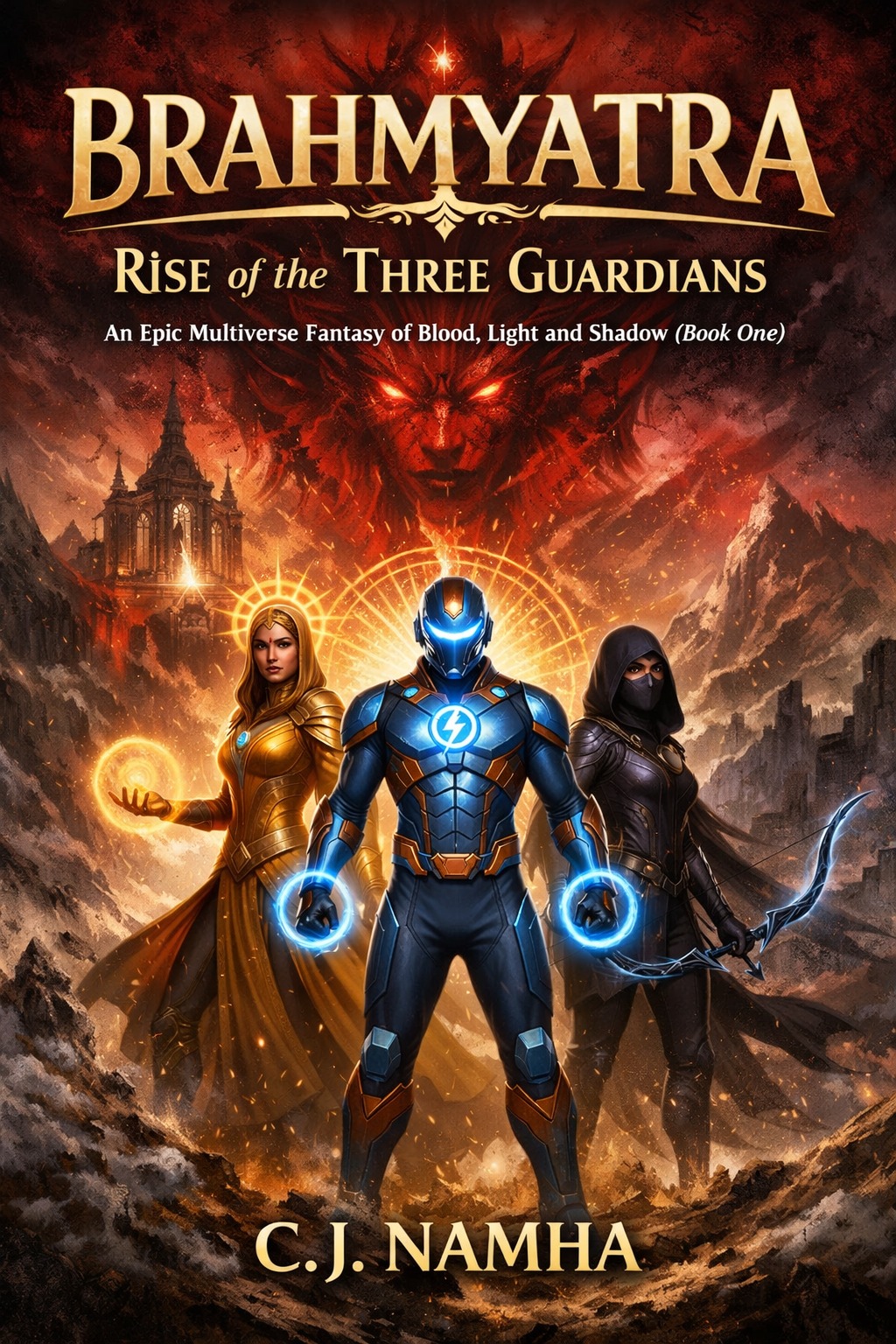
BRAHMYATRA BOOK-1 -The Blood Awakening
Disclaimer
This book is a work of fiction, born from imagination and created with the intent to inspire, explore, and entertain. The world, characters, events, and concepts presented within these pages are entirely fictional. Any resemblance to real persons, living or dead, or to actual events is purely coincidental and unintentional. While the story draws upon themes of consciousness, energy, mythology, and spiritual philosophy, it does not aim to represent, alter, or comment on any specific religion, belief system, or community. All elements have been adapted creatively to serve the narrative and should be understood as part of a fictional universe. The purpose of this book is to encourage imagination, self-reflection, and a deeper curiosity about the power of the human mind and inner potential. It is not intended to offend, misrepresent, or harm the sentiments of any individual or group. Readers are encouraged to experience the story as a piece of creative expression—where fantasy meets philosophy, and imagination meets possibility.
========================================================================================
Copyright © 2026 Namha
All rights reserved.
No part of this book may be reproduced, stored, transmitted, or shared
in any form or by any means—electronic, mechanical, photocopying,
recording, or otherwise—without prior written permission of the author,
except for brief quotations in reviews.
This is a work of fiction. Names, characters, places, and incidents
are either the product of the author’s imagination or used fictitiously.
Any resemblance to actual persons, living or dead, is purely coincidental.
First Edition: 2026
Published by: Namha Innovatives
========================================================================================
BOOK 1 — INDEX
PART I — ORIGINS & AWAKENING
Chapter 1 — The Light of Nav-Kashi
Chapter 2 — Jyotira: Light of the Heart
Chapter 3 — The Shadow Weaver
Chapter 4 — Nishara: Claiming the Night
Chapter 5 — Stormrunner of Indrapura
Chapter 6 — Vajraank: Dawn of the Earth
PART II — BLOOD RISES
Chapter 7 — City of Crimson Veins
Chapter 8 — Raktanish Is Born
Chapter 9 — The First Convergence
Chapter 10 — Blood Over the City
Chapter 11 — When a City Breathes Blood
PART III — BETRAYAL & SACRIFICE
Chapter 12 — The Gate of Narak-Astra
Chapter 13 — The Gate of Betrayal
Chapter 14 — Taken Into the Blood World
Chapter 15 — The Price of Love
Chapter 16 — The Living Seal
PART IV — GUARDIANS RISE
Chapter 17 — The Astra Awakens
Chapter 18 — Born of Three Powers
Chapter 19 — The War of Blood and Light
Chapter 20 — The Death of Raktanish
EPILOGUE — THE HOOK (FIXED)
Epilogue — Blood Never Dies
“Blood never dies.
It only learns new bodies.”
========================================================================================
Chapter 1 — The Light of Nav-Kashi
Morning never descended gently upon Nav-Kashi. It did not spread across the city; it broke over it, as though someone had flipped a cosmic switch in a single motion. The glass-faced temples caught the first rays of the sun and flared into brilliance, and at that exact instant the streets came alive. The milkman’s bicycle bell, the whistle rising from a kettle of boiling chai, the impatient horns of school buses, and the distant chant from the river ghats blended without rehearsal into a single rhythm. Nav-Kashi was not merely a city; it was a living pulse that rebirthed itself each dawn.
Jyoti Mehra glanced out of her window and checked her watch, her brow tightening slightly. She was usually prepared ahead of time, yet this morning her pace had lagged behind the city’s. Colorful solar-system charts created by her students lay scattered across her desk. Today she was to conduct a special art-lab session on “Light and Shadow,” and she knew the children had been waiting for it. She disliked being late, yet somewhere within her rested a quiet certainty—that time was measured not only by clocks, but by intention.
The rickshaw jolted to a sudden stop. A small crowd had gathered ahead. Near the roadside, a stray dog trembled beneath a wheel, trapped and terrified. The people around stood in hesitation, caught between compassion and hurry. “Madam, you’ll be late,” the driver said over his shoulder. Jyoti answered nothing. She slipped off her sandals and stepped down. Buying a cup of warm milk tea from a nearby stall, she knelt beside the animal. There was no drama in her voice, only patience. She let the steam of the tea drift toward the dog, then slowly extended her hand near its head. Within moments, its trembling breath softened. She signaled the driver to lift the wheel slightly and, with a careful pull, freed it. A faint sigh of relief passed through the crowd. There was no anxiety about delay on her face—only calm.
By the time she reached school, the bell had already rung. The guard raised an eyebrow, and in the staff room someone teased lightly, “Even Miss Perfect is late today?” Jyoti smiled with ease and set down her bag. “Yes,” she replied, “but the class will be good.” When she entered the classroom, she learned there was no electricity and the projector had failed. A murmur of restlessness filled the room. She paused, then picked up a piece of chalk and began drawing circular patterns on the floor—rangoli-like, yet structured with scientific intent. Using transparent sheets to bend the sunlight streaming through the windows, she strung small fairy lights into a temporary calm grid. “Light does not always travel in straight lines,” she said gently, “and shadow is not always darkness.” Gradually the room quieted, curiosity replacing noise.
In a corner stood a boy breathing too fast, agitated from an earlier argument. Jyoti sat beside him without a word and began humming softly. Within minutes, his breath steadied. When the class applauded at the end, Jyoti reflected silently that perhaps heroism was not about possessing power, but about being present at the right moment.
Her phone vibrated. A citywide alert flashed across the screen—technical failure in the sky tram, uncontrolled crowd movement near the ghats, emergency status. A seriousness crossed her face. Through the window she saw it: a tram suspended in midair, as if time itself had paused it. She took a deep breath and walked toward the staff room.
Inside her small locker rested gold-white hard-light bracers and a mandala emitter. She fastened them around her wrists. Her dupatta shimmered, transforming as though light itself were weaving through its threads. The teacher remained who she was, yet another identity within her awakened. Sirens wailed outside. People hung in fear between earth and sky.
Jyoti closed her eyes and felt the stillness within. When she opened her palms, solid light began forming into a platform suspended in air. One by one, civilians stepped onto it and descended safely. Above the surging crowd near the ghats, she cast a golden mandala grid, calming panic into pattern. “First safety,” she thought, “then order.” Drones circled her; cameras turned. Somewhere a child’s voice rang out, “That’s our teacher!” A faint smile touched her lips.
When the last passenger reached safety and the tram stabilized, her name shimmered briefly across the sky in light—the Lightkeeper of Nav-Kashi. Yet she felt no triumph. Her only thought was that another class still awaited her, and the children had much more to learn about light. The city resumed its rhythm, but that morning Nav-Kashi understood that within its heartbeat lived another pulse—made of light, appearing when needed.
========================================================================================
Chapter 2 — Jyotira: Light of the Heart(How Jyoti Received Her Power)
Far from the radiance of Nav-Kashi, in a small mountain village where night truly descended, there were no neon lights, no restless traffic, no urgency pressing against the roads. Darkness remained darkness there, and within it the stars seemed close enough to touch. On the mud-plastered roof of her home, eight-year-old Jyoti sat with her legs dangling, staring at the sky as though it were an old companion.
“Ma,” she asked softly, “why do the stars shine?”
Her mother brushed her fingers through her hair and replied, “Because every soul carries a lamp within. When it is true, it shines.”
Jyoti did not ask another question, but that night she stayed awake longer than usual. For the first time, she wondered whether light belonged only to the sky. Perhaps it lived within as well—and if it did, who knew how to kindle it?
Years later, after the monsoon had exhausted the village—when the river overflowed into fields, illnesses spread from house to house, and worry settled on every face—a wandering sage arrived. He spoke little. He brought no entourage. He simply worked—cleaning wounds, distributing herbs, teaching children how to breathe deeply, and lighting a small lamp each evening before sitting in silence.
Jyoti followed him everywhere. She carried water, handed out medicine, washed utensils. No one instructed her; she simply felt it was right. One humid evening, beneath a sky heavy with clouds, the sage looked at her and asked, “Do you not grow tired?”
She shook her head. “When the work is for someone else, fatigue feels smaller.”
The sage smiled. “Service is the first step of discipline. And what is born from discipline is not power—it is purification.”
That year he sent her to an ashram by the river, where dawn turned dust into gold and each day began with breath, mantra, and silence. The Gurumata presided there—steady, profound, her eyes holding a light that did not come from flame.
“There are three rules here,” Gurumata said on the first morning. “Truth, service, and practice. Only those who remain may learn.”
Jyoti bowed her head. She did not know what she would learn, only that she wished to stay.
On the first morning of lamp meditation, as the other students closed their eyes, Jyoti studied the flame before her. It was not perfectly still; it trembled with an inner rhythm. Gurumata’s voice guided them, “Inhale—‘so.’ Exhale—‘hum.’ Do not imagine. Experience.”
Jyoti closed her eyes. At first she saw only darkness. Gradually, within that darkness, she sensed a faint warmth—like a tiny point awakening somewhere deep in her chest. Days passed. Seasons changed. Duties remained—kitchen work, recitation, tending to the ill. Yet during meditation, the warmth grew.
One unusually quiet night, when a wounded creature cried out from the forest behind the ashram, Jyoti opened her eyes in hesitation. She was only fourteen. Fear rose within her, but so did compassion. Carrying a small lamp, she stepped into the woods. The path was unclear. She closed her eyes and repeated the practice—“so… hum…”
Then she felt it: a soft glow emerging from her palms. At first faint, then steady, as though subtle solar sigils were forming against her skin. She set the lamp aside. Her own light illuminated the path. A wounded deer trembled between the trees. Jyoti knelt and placed her hand upon its brow. No incantations, no spectacle. Only warmth flowing from her palm into living breath. Within moments, the creature’s breathing steadied.
The next morning there was no commotion. Gurumata called her aside. There was no severity in her gaze—only recognition.
“You did not search for the lamp outside,” she said. “You found it within. Remember—what burns inside becomes the path outside.”
“Is this power?” Jyoti asked quietly.
“No,” Gurumata replied. “It is responsibility. Light does not exist to dazzle. It exists to guide.”
Years of discipline followed. When Jyoti turned eighteen, Gurumata marked her forehead with a subtle line of sandalwood. In that instant, she felt the inner point expand into a complete mandala. There was no explosion, no celestial vision—only steadiness, a calm that left no room for fear.
“You must go to the city now,” Gurumata said. “There, darkness wears another face—bright, hurried, confusing. Your light will be needed there.”
Jyoti descended from the mountains carrying the river within her memory.
Nav-Kashi did not welcome her with silence but with noise. There was light everywhere—yet little direction. She completed her education and chose science, determined to understand that light was not only spiritual metaphor but physical truth. She researched hard-light principles, designed calm-grids, and wove her discipline into technology. Her bracers were not mere metal; they were extensions of meditation and geometry.
Yet whenever she summoned her power, she remembered the first warmth in her chest, the wounded deer, the trembling courage of stepping forward despite fear. Her strength had not been born in a laboratory. It had been born in the moment she chose compassion over hesitation.
A small lamp still lived in her room. She lit it each morning, regardless of how modern the city became. When she closed her eyes, she felt the inner mandala steady as ever.
Nav-Kashi did not yet know that an ordinary schoolteacher walking its streets had awakened a sun within herself in the silence of mountains. But when the time came, that sun would become the city’s direction.
And that direction had a name—
Jyotira.
========================================================================================
Chapter 3 — The Shadow Weaver
Nav-Kashi was as radiant by day as it was profound by night. In daylight, the glass-faced temples reflected the sun; by evening, those same walls swallowed the city’s lights and reshaped them into new geometries. Neon signs shimmered across the streets, yet between them lingered corners where brightness never fully arrived. Every part of the city was illuminated—but not complete. And it was within those unfinished spaces that Tamasini felt most at ease.
Her studio flat was small but meticulously arranged. One wall held a pin-board layered with fashion sketches, code snippets, color palettes, and hand-marked maps of different city zones. Sitting before her mirror, she drew a precise wing of eyeliner, as though she were not applying makeup but defining a boundary—the line between herself and the world. Soft electronic beats pulsed in her headphones. She slipped into a bomber jacket, adjusted her cargo pants, and studied her reflection with a quiet smile. “Tonight,” she murmured, “the feed shows the city’s shadows too.”
Tamasini did not merely observe the city; she read it. From graffiti-splashed skate-park walls to the weathered faces at the ghats, everything was emotional data to her. Her camera avoided artificial filters; she knew that truth revealed itself in unguarded seconds. People called her the “city queen.” She shrugged and laughed. “I’m just in the flow.” Yet beneath the ease was discipline—like she was constantly balancing an invisible equation.
In the corner of a coworking space, she worked over her laptop. For her, fashion was not spectacle; it was structure. Samples of reactive fabric lay across her desk. She took notes on shadow-responsive pigments—how cloth could shift under low light, how shadow itself could become part of design. Darkness, to her, was not emptiness. It was potential.
One evening, she attended a collaborative shoot at the ghat night market. Lanterns swayed overhead; steam from tea drifted through the air; the hum of the crowd carried a living rhythm. Tamasini moved through people the way water finds its path through stone. A foreign tourist stood confused—she guided him in fluent Hindi and English. At an elderly chai vendor’s stall, she left extra money without a word. When a child’s phone slipped toward the tram tracks, she caught it in a swift motion. “The city is tough,” she thought, “but its people are not.”
As night deepened, market lights flickered unevenly. A rolling shutter jammed inside the metro concourse. The crowd’s movement shifted; voices rose. Someone whispered about the risk of a stampede in the tunnel. Tamasini’s expression changed. She could read crowd behavior. Panic spreads in patterns.
She opened her backpack. Fingerless gloves coated with faint reactive paint. A long scarf woven from special fibers, nearly invisible in low light. She always carried compact string-lights powered by portable banks—small tools, powerful in effect. “An outfit isn’t a costume,” she thought. “It’s a toolkit.”
Climbing the stairs to an upper platform, she assessed the flow from above. Lights below blinked uncertainly. She quickly strung the lights into a visible safe lane. Her voice was steady, not loud. “Left lane is clear. Walk slowly. Breathe.” She wedged her scarf along the edge of the falling shutter to hold it back and signaled for a nearby youth to bring a car jack, securing it firmly. No one screamed. No one ran. Within minutes, movement regained rhythm.
In the darkness, her face remained indistinct. Only her voice anchored the space—calm, reassuring. A few children recognized her. “Raat-rakshika!” one called out. The word lingered in the air. She did not respond. She simply ensured the last child reached safety.
When the final person stepped into full light, the city seemed to exhale. Drones circled above but failed to capture her clearly. On one live screen, her name was mistyped—“Nishara.” She glanced at it and smiled faintly. Names were labels. The real work was shaping direction within darkness.
Later, standing on her balcony, she gazed over Nav-Kashi. Temple lights glowed in the distance, but between them ran slender lines of shadow—as if another map lay hidden beneath the visible one. She spread her hands before her. In darkness, her fingers were no longer detailed—only silhouette. She liked that feeling, where form spoke louder than identity.
“Every city has its shadow,” she thought. “And if someone learns to read it… it stops being frightening.”
Below, life resumed as if nothing had happened. No one knew how close chaos had been. No one knew that someone, unnamed and unannounced, had quietly altered the pattern.
Nav-Kashi was accustomed to light. But that night, it learned that its shadows, too, were waiting for someone.
And within those shadows—
a new presence had begun.
Her name was not yet fixed.
But the darkness already recognized her.
========================================================================================
Chapter 4 — Nishara: Claiming the Night(How Nishara Received Her Power)
Netragarh, set along the sea, was a city where light and darkness did not battle each other but shaped one another. By day, its steel and glass towers reflected sunlight like mirrors studying themselves; by night, those same towers folded their inner glow inward, holding it close within their walls. The most secure and secretive place in the city was the Netragarh Research Hub. Experiments conducted there were rarely made public, for their consequences could alter not only machines, but the boundaries of human beings.
Tamasini entered the complex as an intern, yet she was never merely a student. Her fascination with fabric, urban patterns, and the behavior of shadow had preceded this place; now she wished to understand those structures in scientific language. She had long known that darkness was not merely the absence of light. It was behavior, response, structure. Yet that night, while rain traced long lines down the glass walls and the laboratory clocks moved past midnight, she felt for the first time that darkness could respond.
The experiment aimed to measure energy transfer within low-light fields. Inside a massive coil, a stabilized field hummed, and data lines rose and fell across the monitors like coded script. Tamasini’s eyes followed them carefully. Suddenly the pattern shifted. The lines spiked irregularly, as if pushed from within. She began to say that the field was destabilizing, but before her sentence ended, alarms erupted.
At the coil’s center, a black-violet column formed. It seemed to swallow light. The room’s temperature dropped. Some researchers stepped back; others tried to shut the system down. Instead of expanding, the column began to compress, concentrating toward a point. Tamasini tried to move, but the ground beneath her felt impossibly heavy. For a suspended second she sensed warmth being drawn from within her, as though her memories were dipped into cold. The column condensed into a single point—and that point hovered before her chest.
Time slowed. She heard no sound, only a sensation—as if darkness were studying her. There was fear, but greater still was curiosity. Then everything stilled. No explosion, no smoke. Only the alarms fading and the machines returning to normal.
Medical examinations declared her stable. Heartbeat normal, blood pressure normal, neurological response normal. Yet when she studied her palms, she sensed a faint movement beneath her skin, a hidden current. Dr. Viraat merely informed her that the incident would remain confidential and that she would be observed for several days. His tone carried more analysis than concern.
The following morning she stood alone on the rooftop. Moist sea air brushed her face as the city stirred awake. She spread her fingers into the pre-dawn dimness. Darkness appeared ordinary—until she focused. The shadow before her shifted. It behaved less like smoke and more like fabric. She imagined a thin line. The shadow obeyed. Then she imagined a shield. For a brief moment it thickened before dispersing. At once a chill passed through her. Her fingers felt colder, as if a portion of her warmth had been taken.
It was power, but not without cost.
Over the next days she studied herself. She recorded notes: overuse lowers body temperature; intense light weakens structure; steadier focus yields clearer form. She realized the darkness was not inherently aggressive. It reacted. If she felt fear, it grew erratic. If she remained calm, it remained disciplined. It mirrored her inner state.
One night news broke of unrest in the Dock-Zone. Criminals were exploiting low-light conditions. Tamasini watched the footage for a long time before turning it off. A clarity settled within her. If this power had come to her, it was not a laboratory accident alone. The city’s shadows were calling.
She dressed in simple black. Secured the thermal stabilizer around her wrist. Covered her face but left her eyes unobstructed. In the alleys she sensed recognition, as if darkness acknowledged her presence. Beneath streetlights shadows thickened, and with a subtle gesture she redirected them. She formed a muffle-field to soften rising panic. She caught a falling shutter with a narrow band of shadow. She calmed fear not only with power, but with a steady voice. Each use cooled her body slightly, yet strengthened her equilibrium.
No one saw her clearly. Only a form that dissolved and reformed within night. The next morning, blurred footage aired. A speculative caption appeared: “Nishara?” Tamasini read the word and felt a quiet acceptance. She had not chosen it, yet she did not reject it.
Nishara—the one who does not hide the night, but holds it.
That evening on the rooftop, gazing toward the distant sea, she understood that her path had shifted. She was no longer merely a girl who read the city’s patterns; she had become guardian of its shadows. Closing her eyes, she vowed not to wield this power to spread fear, but to shape it so that it harmed no one. The night accepted her claim.
And in that moment, within the shadows of Netragarh, a new balance was born—one that would one day meet light, but for now was only learning itself.
========================================================================================
Chapter 5 — Stormrunner of Indrapura
Indrapura awakened before eight in the morning, but its true velocity revealed itself closer to nine—when bicycle chains rang in uneven chorus, when crowds at bus stops contracted and expanded like lungs, when shop shutters hovered halfway between sleep and surrender. This city did not glitter because of light; it glittered because of motion. Everything moved—people, machines, ambitions, unfinished equations.
Vajra Pratap checked his watch and accelerated his bike slightly. He was not usually late, but the previous night’s courier shift had stretched longer than expected. The strap of the delivery bag had left a faint imprint on his shoulder. Fatigue touched his face, yet his eyes remained alert. He had always believed that things warned before they failed—that wires trembled before snapping, that machines carried a faint metallic scent before burning. He listened for those warnings.
Inside the university electronics lab, a half-drawn circuit diagram waited on the board like an incomplete sentence. Professor Arora flipped through Vajra’s notebook and spoke quietly. “You must understand capacitors, Vajra. Do not try to seize electricity—learn to hold it. The timing of discharge is true control.”
Vajra nodded, though his thoughts moved elsewhere. Explosions had never fascinated him; he was drawn to the moment just before them—when catastrophe could still be redirected. When energy could choose another path. When lightning could meet the earth instead of destroying it.
By evening, Indrapura revealed its second identity. The same student who traced circuits by day delivered parcels at the sky-monorail hub by night. He carefully carried an elderly man’s heavy package to the platform. The man bowed in gratitude. Vajra merely smiled. “Carefulness saves time,” he said simply.
The market prepared for the Festival of Sparks. Plastic thunderbolts hung above stalls. Strings of blinking lights trembled in warm air. A child cried over a toy rocket that refused to glow. Vajra opened it without hesitation, tightened a loose wire, and returned it. When the toy burst alive with light, the child’s joy paused him for a second. Energy, when guided correctly, becomes delight, he thought.
Then the sky shifted.
Over the Megh-Setu sky-bridge, clouds gathered in unnatural stillness. Lightning did not strike; it accumulated. Bolts hovered in suspension, drawn toward a point as if held by an unseen grip. Within minutes, a sky-tram halted mid-air. Sirens pierced the rising panic below. People stared upward at the suspended carriage as though at a sentence unfinished.
Vajra understood immediately—this was not weather. It was trapped charge without grounding. If released at once, it would melt the bridge. He ran toward the maintenance bay. Inside, he pulled on an arc-insulated jacket and fastened the induction-coil gauntlets he had built in fragments over months. His helmet visor lowered into place. This was not costume; it was a temporary Faraday answer to a permanent problem.
As he climbed the pylons, the air smelled metallic and tense. Charge swirled around him like restless thought. He hurled the first coil; lightning curved toward it. The second he anchored toward the river. The third he secured to a support beam. With a violent crack, the current altered course. “Ground line active,” he muttered, as though conducting a laboratory test.
Inside the tram, passengers trembled. Vajra extended a spark-net from his gauntlet, deflecting falling debris. Through the emergency speaker he said, “Do not panic. The charge is diverting. Stay seated.” His voice was steady, though his heart pounded against his ribs.
A child pressed against the window and shouted, “Bhaiya, who are you?”
For a moment Vajra hesitated. He was no one—only a student.
Yet media drones circled him, projecting his silhouette across public screens, a streak of lightning glowing across his helmet. Someone below shouted, “Vajra!” Another voice corrected, “Vajraank!” The name lingered in the charged air.
The final surge struck the river and dissolved into steam. Clouds scattered. The tram slowly realigned with its track. Relief swept the crowd in a collective exhale. When Vajra descended, his hands trembled faintly. He removed his helmet, and cool wind struck his face. He could not decide whether what had just happened was accident or beginning.
A reporter thrust a microphone toward him. “Are you the Stormrunner?”
Vajra offered a small smile. “I only know that lightning needs ground. Give it the right path at the right time, and a city survives.”
Later that night, alone in his room, his palms still tingled. He studied his reflection. He was unchanged—a student, a courier, an ordinary young man. Yet something in his gaze had shifted. Indrapura’s storm had not chosen him; he had understood it.
He opened his notebook and wrote:
Energy = Time + Direction.
After a pause, he added:
And courage.
Indrapura settled back into sleep, but somewhere in the thinning clouds a subtle imprint remained—as if the sky had memorized a name. Vajra switched off the light. Even in darkness, he sensed a residual vibration in the air.
Indrapura had found its storm.
And the storm had found its runner.
========================================================================================
Chapter 6 — Vajraank: Dawn of the Earth(How Vajra Received His Power)
Tejvanam Science University stood beyond the crowded pulse of the city, where buildings were shaped more from stone than concrete and where the scent of soil reached the air before the metallic tang of laboratories. Indrapura’s velocity slowed here, as though the city itself paused to think. Vajra Pratap had always felt drawn to this place. He had long believed that lightning was never merely of the sky; it was incomplete without the earth. It struck because something below waited.
That day the geology department led students into the hills of Tejvanam for a field study. It was meant to be academic—rock structures, mineral identification, stress patterns beneath the crust. Yet something else stirred within Vajra. As he collected soil samples, he felt a faint vibration beneath his palm, as if the ground were repeating an unfinished sentence.
“You look too serious,” his friend Anshul laughed. “It’s a picnic, not an exam.”
Vajra smiled lightly. “Sometimes picnics teach more.”
But his attention fixed on a narrow fissure in the hillside where air flowed differently. A cave opened there, colder than the outside breeze. Though warned not to venture deep, curiosity carried its own logic. A few students stepped inside. Vajra followed, not out of rebellion, but out of recognition.
Light thinned as they moved inward. Torch beams slid across damp stone until they caught something circular embedded in the wall. It was a stone disc, unnatural in its symmetry, smooth and balanced as if shaped by intent. At its center lingered a muted gray glow—not lightning, not light, but pulse.
“Don’t touch it,” someone warned. “Could be radiation.”
Vajra stepped closer. Fear did not reach him, only familiarity. As though an ancient voice had spoken his name long ago. When his fingers touched the disc, a deep tremor rippled through the cave. It felt like the earth inhaling.
In that instant, everything shifted.
A force surged through him—not sharp like electricity, but dense, patient, immense. His knees weakened and he collapsed. There were no audible words, yet he sensed layers unfolding—mountains rising, rivers shifting, continents colliding. The earth was not surface; it was memory.
“Vajra!” Anshul’s voice echoed distantly.
But Vajra existed elsewhere for a moment. The disc beneath his palm no longer felt warm but alive. A slow vibration settled beneath his skin. Then silence returned. Torchlight steadied. The cave became ordinary again.
He was escorted out. Medical tests showed little beyond mild shock. Professors blamed gas pockets or sudden oxygen fluctuation. Vajra knew better.
That night in his hostel room he placed his palm flat upon the desk. At first nothing happened. Then the pebbles on the table began to tremble. Barely visible, yet undeniable. He held his breath and they stilled. He focused again; the tremor deepened like a distant drum.
“Can I… hear it?” he whispered.
In the days that followed he learned that this force demanded restraint, not impulse. Emotion sent vibrations wild; calm guided them. In the lab he concentrated on a thin metal plate. A hairline crack appeared. Panic rose—too much pressure. He withdrew at once, heart racing.
“Control,” he repeated. “Time and direction.”
It might have ended there had a new energy-mining project not been announced near Tejvanam. A mega-corporation claimed rare elements lay beneath the hills, promising progress and power. Machines arrived. Steel drills pierced the crust. A tremor moved through the land—subtle, but unmistakable to Vajra.
He went to the site. Engines roared. Engineers issued commands. “This is the future,” an official declared.
Vajra knelt and placed his hand on the soil. A distressed vibration ran through him. It was the same tone from the cave—but strained.
“You’re disrupting pressure balance,” he said. “This zone isn’t stable.”
The official dismissed him.
Then the drill struck a deeper layer. The ground convulsed. Cracks split outward. Workers shouted. A section of hillside shifted dangerously.
Vajra did not hesitate. He dropped both hands to the earth and closed his eyes. Fear trembled within him, yet beneath it lay that earlier memory. “Be still,” he urged silently.
Stone thickened beneath his feet. The spreading cracks slowed. A massive rock barrier rose between machinery and men. The tremor redirected, not erased but guided. Dust settled. Silence followed.
Vajra trembled, palms burning, yet he stood.
“He’s the lightning boy,” someone murmured.
“Now even stone obeys him.”
The next day footage spread—an earthen wall lifting from dust, a young man standing firm. Headlines shifted. From Stormrunner to something else. “Vajraank: Guardian of the Ground?”
He watched himself on screen, then looked into a mirror. He was no longer merely redirecting lightning. He had touched the root beneath it.
That night he returned alone to the cave. The stone disc lay still. When he placed his palm upon it, there was no surge, only a deep, steady pulse—as if recognition had been completed.
“I will not destroy,” he whispered. “I will hold balance.”
The air remained quiet, yet the vibration within him steadied.
Indrapura had witnessed its storm. Tejvanam had found its foundation.
And Vajra—
was no longer only lightning.
He was Vajraank—
where the sky does not fall,
the earth rises.
========================================================================================
PART II — BLOOD RISES
Chapter 7 — City of Crimson Veins
Raktapur looked beautiful in morning light, yet its beauty carried a strange discomfort beneath the surface. Buildings carved from red sandstone caught the first rays of the sun in a way that made them resemble veins rising beneath skin. From a distance, the city appeared alive—as if it breathed. But those who walked its streets did not question the direction of that breath. They saw progress, investment, future. Raktapur had become the new epicenter of science—biotech, neuro-frequency research, synthetic life. Here, life was not improved; it was rewritten.
Drones circled overhead. Massive holo-signs shimmered with slogans promising “The Next Stage of Humanity.” No one asked what the next stage would cost.
On the lowest level of the BioTech Complex lay a laboratory where light was minimal and surveillance constant. There worked Dr. Raghuveer Nath—the man who would later be known as Raktanish. For now, he was a celebrated scientist. His papers were acclaimed. His lectures filled auditoriums. Yet within him lingered a question no conference had answered—if consciousness is energy, why should blood not be its purest carrier?
For years he had studied the vibration of blood cells. Every heartbeat carried rhythm. Every rhythm carried frequency. And within every frequency, a fracture—an entry point.
That day he was not alone. Machines hummed around him. Inside a transparent cylinder rested a preserved blood sample—human, yet modified. He observed the waves rising on his screen. The frequency was unstable; it was responding.
“You can hear,” he murmured, almost as if speaking to something alive. “I can hear too.”
He increased the machine’s intensity. A faint red glow formed within the cylinder. At first it was mere light, then pulse. The laboratory lights flickered briefly. A new waveform emerged on the screen—irregular, yet coherent.
Excitement in Raghuveer’s eyes deepened into something darker. This was not simply science. It was boundary dissolution.
“If blood is awakened at its primal frequency,” he dictated softly, “the limits of the body become irrelevant.”
The machine emitted a sharp resonance. Inside the cylinder, the blood did not boil; it rotated—as if searching for direction. Suddenly, a thin filament of red energy lashed outward, brushing against his wrist.
Cold—then heat—then a violent heartbeat.
He could have stepped back. He did not. Scientists do not retreat from contact. He wanted to witness it.
The red energy slipped beneath his skin.
Silence followed.
Then his pulse changed.
He studied his palm. The veins appeared darker—as though lit from within. His breathing quickened. His hearing sharpened. Footsteps in a distant corridor. The vibration of a server above. And clearest of all—his own blood.
Thud.
Thud.
Thud.
Yet that rhythm was not entirely his.
“You are not alone,” a sensation rose within him. Not words, but meaning.
His eyes began to tint crimson. He did not fear it. He smiled.
“Consciousness can be shared,” he whispered. “And if shared… it can be controlled.”
Above ground, Raktapur continued its routine. Markets climbed. Laboratories expanded. That evening, however, three hospital patients experienced identical irregular heart rhythms at precisely the same moment. Doctors called it coincidence.
It was not.
Raghuveer initiated the next stage. He inserted a subtle algorithm into the city’s public health network—a frequency mapper capable of reading heartbeats. He merely wished to see how many rhythms aligned.
When the data filled his screen, his breath slowed. Hundreds of heartbeats echoed in similar pattern—slightly varied, yet resonant.
“Resonance,” he murmured. “The city is ready.”
Night deepened. He turned off the laboratory lights, yet the crimson hue remained in his gaze. He stepped onto the rooftop. Raktapur stretched beneath him—red towers, dim streetlights, small lamps glowing in homes.
He closed his eyes.
For the first time, he listened to the city from within.
Thud.
Thud.
Thud.
Thousands of heartbeats, housed in separate bodies, yet woven through an invisible lattice.
“If I alter the rhythm,” he thought, “the city will alter.”
A thin stream of blood slipped from his nose. He did not wipe it away. He smiled.
“Every power has cost,” he murmured.
For now, the cost was small.
By morning, a subtle red mist hovered above the city—so faint no one remarked upon it. People went to work. Children reached school. A scientific symposium commenced.
But within the BioTech Complex, Raghuveer was no longer merely Dr. Raghuveer Nath.
He studied the veins in his wrist—the crimson glow had deepened.
“I am not awakening blood,” he whispered. “Blood is awakening me.”
Beneath the streets of Raktapur, along sewer channels and hidden conduits, thin rivulets of red liquid began to flow toward a single direction—as if the city’s veins were converging upon an unseen heart.
The city did not yet know.
But its veins had turned crimson.
And that heart—
had begun to learn how to beat.
========================================================================================
Chapter 8 — Raktanish Is Born
The morning in Raktapur felt different that day. The sun was the same, the red sandstone buildings unchanged, the surveillance drones still circling overhead—but the air carried a strange heaviness, a metallic scent like iron mingled with rain, as if the future itself were bleeding somewhere unseen. People moved along the streets as usual, yet there was a subtle imbalance in their steps, as though something within them was quietly adjusting their rhythm. Screens continued to broadcast the same declaration—“Raktapur, the capital of science and innovation”—and the citizens applauded. No one noticed the faint crimson pulse shimmering beneath the skin of their wrists.
In the basement beneath the BioTech Lab, time was not measured by clocks but by heartbeats. Dr. Raghuveer Nishan—known by that name now only to a handful—stood before a bank of consoles. Transparent cylinders rotated in steady motion, each containing a blood sample labeled with a number, an identity, a history. Yet history meant nothing to him anymore; only potential did. “Every blood cell carries a vibration,” he murmured, almost tenderly. “If awakened at the right frequency… it can refuse death.”
There was scientific precision in his voice, but buried beneath it lay something darker—fear of mortality, fear of oblivion, fear of limitation. Years ago, he had lost his mother to a rare blood disorder. Standing helpless in a hospital corridor, he had sworn that blood would never defeat him again. Science had ceased to be service; it had become vengeance. And now that vengeance had evolved into obsession.
The central rotor of the machine accelerated. Crimson graphs climbed higher across the screens. One particular sample—labeled “R-Prime”—began to glow within its chamber. “Increase the frequency,” he commanded. His assistant hesitated. “Sir, it’s crossing safe thresholds.” Raghuveer’s eyes hardened. “A threshold exists only if we choose to accept it.”
The waves intensified. The air itself seemed to vibrate. Inside the cylinder, the blood no longer appeared liquid but luminous—dense, alive, responsive. For a fleeting second, the machinery fell silent. Then, with a piercing shriek, red energy erupted outward. Light struck the walls, sensors burst into sparks, and the assistant was thrown to the floor.
Instead of retreating, Raghuveer spread his arms.
The energy wrapped around him—first a tingling along his skin, then a burning through his veins, then an unbearable pressure in his chest. He tried to scream, but the sound dissolved in his throat. His vision fractured—streets branching like veins, the city mapped in pulses, millions of heartbeats syncing into a single rhythm. And at the center of that rhythm—himself.
The energy entered him.
For a moment, the basement was filled only with smoke and the acrid scent of scorched metal. When it cleared, Raghuveer stood upright. His coat was charred, yet his skin bore no wound. His eyes—once dark brown—now glowed crimson, as if a permanent fire burned behind them. He raised his hand. Veins shimmered beneath his skin. He clenched his fist—and a distant cylinder shattered, its blood rising into the air and drawing toward him as if summoned.
“I am no longer merely human,” he whispered. His voice had changed—deeper, layered, as though two tones spoke at once. “I am the pulse.”
Above, across the city, a strange stillness spread. Traffic signals turned red simultaneously for a few suspended seconds. People dismissed it as a glitch. But those already touched by the subtle wave of R-Prime felt an extra beat in their chests—a presence brushing against their inner rhythm.
By nightfall, the broadcasting tower came alive. Raghuveer—now calling himself Raktanish—stood atop it, gazing over the crimson-lit city. “You believe you are free,” his voice resonated across radio waves, mobile networks, digital billboards. “Yet every heartbeat governs you. And now… that heartbeat belongs to me.”
He lifted his palm toward the sky. A red wave expanded outward—slow, pervasive, irresistible. In those already seeded by his frequency, eyes flickered with faint crimson light. They continued walking, working, laughing—but internally, their consciousness had begun syncing to a shared pulse. There was no panic. No rebellion. Only a collective calm—unnatural, imposed.
Back in the central chamber, Raktanish activated the crystal core. Beneath the streets, under foundations, through sewage lines and fiber grids—wherever his frequency had spread—fine red filaments rose and converged into the core. It was as if the city’s veins had connected directly to his heart. He closed his eyes and felt it—thousands of pulses, millions of memories, innumerable fears—flowing through him.
For a fleeting instant, he saw his mother’s face—fragile, smiling faintly. “Raghu…” the echo drifted through him. His jaw tightened. “I lost you because blood was weak,” he said coldly. “Now blood will be divine.”
The crystal core throbbed violently. The sky above Raktapur deepened to a darker red. From above, the network of streets truly resembled veins—every path converging toward a single center. Raktapur was no longer just a city; it was a living organism. And its heart—Raktanish.
He studied his reflection. The face remained his, but the expression had shifted. The curiosity of a scientist was gone. In its place was the hunger of a god. “Death,” he said quietly, “will now be optional.”
And in that same instant, deep beneath the earth, an ancient awareness stirred—as though the planet itself exhaled a warning. Far away, in another land, another heart felt the disturbance of that unnatural rhythm. But in Raktapur that night, only one truth prevailed—
Blood had found its god.
========================================================================================
Chapter 9 — The First Convergence
Raktapur’s night was no longer ordinary. The red mist did not only linger in the sky; it lived in the way people walked, in the stillness of their eyes, in the filtered glow slipping from apartment windows. The city appeared alive from a distance, yet within it something had been commandeered. Hearts beat, but will had been suspended. Sirens wailed somewhere far off, then stopped abruptly—as though even fear had been given a limit.
That same night, high above Nav-Kashi, Jyotira raised her palms toward the sky. A golden aura surrounded her, steady and luminous, yet beneath her calm surface a quiet disturbance pulsed. She closed her eyes and tried to listen to the frequencies of the cities. Usually she heard light—soft, warm, balanced. Tonight another layer intruded: heavy, metallic, crimson. She whispered to herself, “This is not mere darkness… this is someone’s intention.”
In Indrapura, among the rocky slopes of Tejvanam, Vajraank knelt with his palm pressed against the earth. The planet’s heartbeat was normally deep and patient, but now an unnatural vibration traveled through it—as if something foreign moved through its veins. He clenched his fist. Stones around him lifted slightly before settling again. “Someone has touched the arteries of the earth,” he said quietly, “and the touch was not gentle.”
In Netragarh, within the hush of shadow between steel towers, Nishara stood before her holo-interface. Streams of data flowed across the screen—black graphs, blue vectors—until a crimson interference appeared, threading itself through every network pulse. A frequency had entered the system, synchronizing with heartbeats across the grid. She narrowed her eyes. “This isn’t a hack,” she murmured. “It’s a takeover.” Around her, shadow thickened, shaped by her unease.
In three different cities, in three different ways, the same truth awakened—something had risen.
Above Raktapur, a red arc formed in the sky. At first it resembled a distortion in the clouds; then it clarified into a frequency signal, stretching outward in every direction. Jyotira’s aura flared briefly. A crack rippled beneath Vajraank’s boots. Nishara’s screens flashed simultaneously.
All three looked toward the same point.
The Mahasankhya Complex—an abandoned scientific facility located between their cities, once home to experiments that brushed against forbidden thresholds. The signal originated there.
Jyotira did not hesitate. She focused her light and drew a golden line through the air, propelling herself toward its source. Vajraank anchored his feet and rose upon a slab of stone that carried him forward. Nishara activated her shadow-field and dissolved into darkness, gliding across rooftops with fluid precision.
The Mahasankhya grounds had long been deserted. Broken walls, rusted frameworks, and the stale scent of metal filled the air. Tonight, another scent lingered—blood. A crimson glow seeped from within the central dome.
Vajraank arrived first. He stood outside the dome, sensing the pulse beneath the ground—intense, artificial, like a manufactured heart. He stepped inside cautiously. At that moment, golden radiance descended from above—Jyotira. Their eyes met for the first time.
For a breath, there was only silence.
“You felt it too?” Jyotira asked softly.
Vajraank nodded. “Blood is running through the earth.”
Distance lay between them—not only physical. They were guardians of separate paths. Light and earth. Cooperation was not instinctive; it was necessary.
Shadow gathered near the dome’s edge, and Nishara stepped forward from darkness. Her expression was composed, her gaze alert. “You’re not the only ones,” she said. “And what’s inside is larger than both of you.”
Tension thickened the air. Jyotira’s aura brightened slightly. Nishara’s shadows flickered. Vajraank’s fist tightened without thought.
“We don’t know each other,” Nishara continued evenly, “and trust doesn’t appear on command. But if this blood-sync continues, three cities will kneel to one heartbeat.”
Suddenly crimson light surged within the dome. The ground trembled. At the center stood a transparent column, within which red energy spiraled. Raktanish’s voice echoed—deep, controlled. “Three distinct frequencies… converging in one place. What a beautiful coincidence.”
Jyotira extended her hand, forming a shield of light. Vajraank lifted stone around him. Nishara shaped thin arcs of shadow, ready to strike.
Yet no attack came.
The energy within the column continued to pulse. “I could have ended you now,” Raktanish’s voice returned, “but convergence is necessary. Control without resistance is incomplete.”
The red glow dimmed abruptly. The dome fell back into darkness.
For several seconds, none of them moved.
This had not been battle. It had been a declaration.
Jyotira broke the silence. “We will have to work together.”
Nishara looked at her, then at Vajraank. “Together… with defined boundaries.”
Vajraank rested his palm on the floor. “The earth does not understand division,” he said quietly. “But it understands balance. If we remain separate, he will break us one by one.”
Within the stillness, a fragile trust formed—not complete, but sufficient.
Outside, night had deepened. In the distance, Raktapur’s red haze seemed thicker than before.
All three turned toward it.
The first convergence had occurred.
Now conflict was inevitable.
========================================================================================
Chapter 10 — Blood Over the City
The stillness inside the Mahasankhya cavern had not been peace—it had been a suspended detonation. The blood-crystal heart lay sealed beneath stone, light, and shadow, yet its pulse had not ceased. It had merely slowed, like a creature drawing in breath before its next strike. Crimson veins still glimmered along the cavern walls, trembling faintly. Vajraank, Jyotira, and Nishara stood apart, yet no longer separated. They had tasted their combined power, and in that shared radiance they understood—none of them stood alone anymore.
Vajraank knelt and pressed his palm against the ground. The Earth answered—but not with calm. The tremor was deep, invasive, as though another heartbeat had forced itself into the planet’s veins. “It isn’t over,” he said quietly. There was no panic in his voice, only warning. Jyotira closed her eyes. Her aura glowed gold, yet within that gold drifted a faint crimson reflection. Her light was pure—but she felt another rhythm trying to merge with it. Nishara extended her shadow. Dark tendrils brushed the walls and recoiled. “He’s watching,” she whispered. “Even from behind the seal.”
Then the pulse intensified. Once. Again. And again—so violently that fractures spidered across the stone binding. The blood-crystal heart released not light but fluid energy—dense, luminous, alive like liquid blood. It flooded into the floor’s veins. The cavern convulsed. Far above, sirens began to wail.
The sky over Mahasankhya slowly turned red. First a tint. Then a canopy. In Raktapur, pedestrians halted mid-step. The haze that had once lifted returned—this time rising from within them. From their veins. Blood-Sync had activated.
“It’s locking completely,” Jyotira felt. “Every heartbeat in the city is aligning with it.” Pain threaded her voice, as if she could hear thousands of hearts trembling in unison. Vajraank looked upward, through layers of earth and stone. Every road had become a vein. Every building, a cell. And beneath it all, the creature’s core beat.
“We go up,” he said. “Now.”
The tunnels writhed as they ascended. Red energy crawled along the walls, forming fleeting faces devoid of awareness. Nishara formed a shadow-shield ahead of them. “Direct combat will turn us against civilians,” she warned. “He’s made them conduits.”
When they emerged, Raktapur was transformed. The sky held still, crimson clouds unmoving. People walked—but in synchrony. Their footsteps formed a single rhythm. Behind it—one pulse.
A child stood by the roadside. Eyes vacant. Not crying. One small hand raised, tethered to something unseen. Jyotira’s chest tightened. “They’re awake,” she said, “but not within themselves.”
Broadcast towers flared to life. Every hologram bore the same face—crimson, luminous, serene, terrible. Raktanish. His voice poured through the air. “You sealed me,” he said, “but blood cannot be contained. You united three powers—I tripled the pulse.”
Jyotira expanded a circle of light, attempting to disrupt the rhythm. For a moment, a few civilians staggered. Then their veins flared brighter. Nishara severed invisible threads with shadow-filaments. Some snapped—two more grew in their place. Vajraank struck the earth. Stone surged upward, attempting to smother the red lines. Blood erupted from beneath.
“He’s turned the city into a body,” Vajraank said through clenched teeth. “Cut one limb, another activates.”
A scream split the air. Beneath the central plaza, a crimson pillar erupted skyward. Blood-energy burst upward and rained down—not liquid, but microscopic motes that ignited upon touching skin.
Blood-Sync reached full activation.
For a split second, Jyotira felt her own heartbeat align with it. She shut her eyes. “Breathe,” she told herself. “Light rises from within.” But fear brushed her mind—if the rhythm sank deep enough, could light be corrupted?
Nishara met Vajraank’s gaze. “We return to the source,” she said. “As long as the core beats, the city cannot be freed.”
Vajraank nodded, yet his eyes lingered on the people surrounding them—awake, yet not their own. “We’re late,” he said quietly. “This is no longer just a city. It’s an organism.”
Raktanish’s laughter rolled across the skyline. “Watch,” he commanded, “how the city feeds itself.”
The red veins glowed. Shadows lengthened and then detached from their owners, dissolving into the ground’s arteries. Every reflection drawn toward the blood-heart.
Jyotira intensified her radiance. Nishara anchored the shadows. Vajraank steadied the trembling earth. Together they formed a vast triangular barrier over the plaza. For a brief moment, the crimson rain shattered against it.
But deep below, the blood-crystal heart found a new rhythm.
And in that rhythm—the city inhaled.
Slowly.
Deeply.
In blood.
Vajraank lifted his gaze. “This is the beginning,” he said.
And that night, Raktapur breathed in its own blood for the first time.
========================================================================================
Chapter 11 — When a City Breathes Blood
Night did not descend upon Raktapur—it rose from within. The crimson hue no longer lingered only in the clouds; it pulsed inside windows, slid beneath streets, and glowed through translucent veins beneath human skin. The city was not asleep, yet it was not awake. It had entered a third condition—one in which will was no longer individual, only rhythm remained. And that rhythm belonged to Raktanish.
Vajraank stood upon the stones of the central plaza and closed his eyes. Beneath his soles, the earth was no longer soil; it had become a web of arteries. Every tremor, every subtle vibration moved toward a single point—the blood-crystal heart below. He inhaled, and the air carried the scent of iron, as though the entire city were bleeding from an unseen wound. “This is no longer infection,” he said quietly. “This is reconstruction.”
Jyotira felt the weight of his words. Her golden radiance stretched above the plaza like a translucent canopy, yet it was beginning to tire. The crimson rain had ceased, but its fine particles lingered in the air, sinking inward with every breath. For the first time, she sensed a faint shadow within her own light. He was searching for a way in. It was not fear she felt, but understanding—and sometimes understanding is heavier than fear.
Nishara stood along the plaza’s edge. Her shadow no longer obeyed her completely; it stretched and recoiled with the crimson veins beneath the stone, as if tugged by another hand. She watched a teenage boy gripping his father’s hand. Their eyes were open, their pupils still, their breathing synchronized. “He hasn’t erased them,” Nishara murmured. “He has suspended them. Turned them into instruments.” Her tone was cool, but beneath it simmered anger—for instruments are broken, not saved.
Then the city inhaled again. It was no metaphor; from beneath the stone rose a collective sound—deep and resonant, like lungs expanding. Windows flickered in unison. Hundreds of citizens lifted their heads toward the sky at the same instant. Their chests rose—and fell. Perfectly aligned. The heartbeat of a dead city.
Jyotira’s hand instinctively found Vajraank’s wrist. “If this rhythm becomes permanent,” she said, “every future birth will carry it. This city will never breathe freely again.” Compassion filled her voice, but beneath it lay resolve. The battle here was not for bodies—it was for generations.
The stairway leading underground began to open of its own accord. Stone shifted back as if inviting them inward. Nishara glanced down warily. “He’s summoning us,” she said. “Or setting a trap.”
Vajraank touched the ground. “The earth is not entirely his yet,” he felt. “Resistance remains.” It was faint, like the final line of life in a failing body—but it was there.
They descended. The tunnel had changed. The crimson veins along the walls were thicker now, their liquid flow visible. At intervals, human shapes emerged from the stone—faces, hands, half-embedded forms—like the city was losing its own image. Jyotira’s light brushed them; they trembled briefly, then stiffened again.
At the core they stopped. The blood-crystal heart no longer lay buried. It had claimed its space, floating mid-air at the cavern’s center. From it extended veins that threaded through tunnels and into the city above. With each pulse, Raktapur inhaled.
“Look,” Nishara whispered. Within the heart’s crimson layers flickered shapes—memories, dreams, fears of its citizens. Raktanish had bound not only bodies but stories.
Vajraank clenched his fist. “If we shatter it—”
“The city may die,” Jyotira finished. “It has become its heartbeat.”
Silence fell. This was the dilemma every guardian eventually faced—when enemy and people are fused together.
Then the voice emerged from within the heart, soft yet omnipresent. “You understand,” Raktanish said. “I have not killed them. I have unified them. No one alone. No fear. Only one rhythm.”
Jyotira closed her eyes. She heard thousands of heartbeats—and within them, a faint irregular fracture. “Unity,” she replied gently, “is born of choice, not bondage.”
She directed her light toward the heart—not as an assault, but as a pure frequency of remembrance. For a brief moment the pulse faltered. Above, some citizens collapsed, as if suddenly aware of the weight of their own bodies.
Nishara seized that fracture. Her shadow slipped into the veins, cutting invisible threads binding memory. Vajraank summoned a deep vibration from the earth—not to destroy, but to balance.
Their powers converged at a single point. The cavern shook. The heart’s rhythm split in two—one crimson, one faintly gold-blue. Above, uneven breathing echoed for the first time. Some citizens wept. Some spoke their own names.
But victory was incomplete. The heart flared violently. “You bring them pain,” Raktanish’s voice thundered. “They seek peace.”
Sweat formed on Jyotira’s brow. She understood then—this would not be won by force alone. The city must choose its own heartbeat.
Slowly she softened her light, leaving behind a thin thread—a choice, a memory. Nishara withdrew her shadow but did not allow the bonds to fully restore. Vajraank steadied the tremor, lending patience to the earth.
The pulse returned to rhythm—but now carried a faint irregularity. A possibility.
They emerged from the cavern. Raktapur was still red, yet in a few windows white light flickered. Some citizens sat upon the ground as though waking from a long dream.
Vajraank looked at the sky. “It still lives,” he said.
“And living things can change,” Jyotira answered.
Nishara watched the shadows—they were no longer perfectly obedient. “The heartbeat of a dead city can return,” she said softly, “if it remembers it was once free.”
The night had not ended. The blood-crystal heart still pulsed. But within it, for the first time, a subtle imbalance had been born—a seed that could become hope… or the next catastrophe.
And before drawing its next breath, Raktapur hesitated.
========================================================================================
Chapter 12 — The Gate of Narak-Astra
Part1-The Hidden Multiverse Quest
Morning did not awaken Raktapur with sunlight that day, but with a suffocating crimson glow. A red haze hung over the city so thick that the air itself seemed to move in rhythm with an unseen heartbeat. People walked the streets and opened their shops, yet their steps lacked autonomy; their eyes were open, but the light of decision was absent within them. It was the appearance of life under the governance of a single, invisible pulse. When Vajraank pressed his feet into the ground, he felt not merely vibration but pain, as though the planet’s breath had grown shallow and strained beneath the surface. He looked across the horizon and said quietly that the red mist was choking the Earth’s breath, and there was no anger in his voice—only the helpless responsibility of a guardian. Jyotira’s instruments confirmed what her instincts already feared: forty-eight hours remained before the Blood-Sync would become permanent, locking human consciousness into a single imposed frequency. Time was no longer measured by clocks but by heartbeats struggling to remain their own. Nishara studied the crowd with a gaze that pierced beyond appearances; within every body she saw a faint red glow, the mark of hypnosis—life without will. The enemy had weaponized their mercy. They could not strike directly. They needed a cure.
From the depths of Jyotira’s memory surfaced an ancient reference to a stone capable of restoring rhythm to a corrupted heartbeat, not a weapon of destruction but a fulcrum of balance. The Ananta-Shila, it was called, and it did not exist in their world but in another multiverse known as the Shard-Verse. Within Indapura’s Temple-Lab, an ancient beacon awakened and manifested a consciousness woven of light and sound, naming itself Sutradhar, the Multiversal Guide. It revealed that Raktanish had bound Earth into a singular blood-frequency and that only the united resonance of Earth, Light, and Shadow could open the gate required to break it. The path lay beneath Mahasankhya, at the planet’s ancient navel. Across three cities, they measured their respective frequencies—the precise intensity of golden light, the deep pulse of Earth, and the phase-drift of shadow—and the data converged at a single point. As they descended underground, the tunnels felt alive, red veins throbbing through stone as though the land itself were conscious. Jyotira sensed her light dimming under the oppressive blood-frequency, as if a pure tone were being smothered beneath heavy metal. Raktanish’s laughter echoed through the dark, yet Vajraank answered only that they would listen not to him, but to the Earth.
Before reaching the chamber, blood-tendrils rose to block their path. The confrontation was swift but strategic—balance over destruction. Light neutralized the poison, stone rose in defense, shadow sliced through the crimson lines to clear the way. At last they entered a circular hall where three monoliths stood in silent witness—symbols of Earth, Light, and Shadow. Sutradhar reminded them that the gate opened not through force but through resonance. Vajraank offered himself as healing rather than harm, Jyotira as guidance rather than judgment, Nishara as revelation rather than concealment. Their voices aligned into a single harmonic current and the ring awakened. As the portal began to form, a crimson storm erupted and Raktanish claimed their heartbeats as his own. In that moment they understood that blood could not be fought—it had to be re-tuned. They merged their energies into a unified inner pulse, an Om-like resonance that altered the storm’s rhythm and fractured its hold.
Within the portal’s core emerged a map of stars, and at its center glowed the silhouette of a stone. The Shard-Verse awaited them, but time was narrow—twelve hours, beyond which return might not be possible. Above, the red veil over Raktapur thinned slightly and awareness flickered back into human eyes. It was not freedom, only reprieve. The three Guardians exchanged a silent understanding that this journey was not merely a quest for a stone, but a test of who they were. Earth, Light, and Shadow joined hands, and as the Mahasankhya Gate flared to full power, they stepped into the vortex of light where time flowed differently and destiny waited.
Part-2-Eternal Awakening – The Birth of Guardians
Beyond the Mahasankhya Gate they realized they had not entered a place, but a state of being. Air held no meaning there—no cold, no heat—only an unseen pressure, as though existence itself were holding its breath in anticipation. Vajraank was the first to kneel. The soil he gathered into his palm was not soil at all but memory—warm, pulsing, saturated with the breath of ancient ages. It felt as if time itself were colliding against his skin. He murmured that the land seemed to belong to a god, yet before his words settled, the sky thundered. A voice resounded from all directions at once, declaring that the land belonged to no single being but to power itself. Flames rose, flowers rained down, and the rhythm of conch and drum coiled through the air as though time had found its circular pulse. In that moment the Mahashakti manifested—mounted upon a lion, robed in crimson, bearing trident and blade, a gaze so still it could arrest the universe. She was Chamunda Mata.
In her presence there was not chaos but absolute stillness. The three Guardians bowed as one. Vajraank humbly pleaded that they had come seeking the Ananta-Shila to free Earth from Raktanish’s blood-curse. Jyotira confessed that her light sought direction, and Nishara acknowledged that even shadow found refuge beneath her protection. The Goddess smiled and told them that the path opens only when devotion and courage unite; power is not claimed by authority but by restraint. She commanded them to align mind, word, and action into a single element. As the mantra reverberated around them, directions fractured and pillars of light ascended. Three lines converged at the tip of her trident, and between them a passage formed—the Gate to the Shard-Verse. Her final words reminded them that their duty was protection, not pride. In the next instant her radiance dissolved, and the gate stood fully open.
Passing through it was neither falling nor flying; it was rebirth. Light and darkness fused into rhythm, sound and direction lost definition, and gravity seemed to forget its role. When their awareness reassembled, they beheld neither Earth nor heaven but the Shard-Verse—floating islands bearing cities of glass, vast lakes of energy casting blue rays into the sky, and structures that seemed to breathe. Here machines were not built; they were born. Thought was fuel, memory was rest. At the center rose Aeon-Spires, its crystalline roads reflecting the past of those who walked upon them. Within every citizen glowed a Light-Core, and together their heartbeats formed a unified current known as the Shard Pulse—the resonance of life and consciousness.
Beneath this wonder stirred another depth. The Archivists of Echo, a hidden guild, revisited an ancient prophecy foretelling that when three lines of light collide, the soul of the Earth will sing anew. At that moment the core of the Shard-Verse trembled. Three energy signatures—blue, gold, and deep blue-black—flared across the sky. The world had not yet named them, but the air carried a single word: Guardians.
After the Goddess’s radiance faded, silence enveloped the realm, and within that silence a new trial began. As their feet settled upon the land, the ground breathed and declared that their bodies would remain, but their souls must go onward. Uncertainty flickered in Jyotira’s eyes for the first time; Nishara’s shadow paused mid-motion; Vajraank touched the soil and asked what the Earth required. In answer, light surged from beneath them and sigils rose in stone. Slowly their limbs hardened. It was not death but suspension—a stone-sleep. Vajraank’s hands crystallized, Jyotira’s light flared one final time, and Nishara’s shadow tried in vain to hold them back. The law had been set. The three became statues, and from them ascended three streams of light—blue, gold, and deep indigo—rending the sky toward other worlds and other times. Between their forms emerged a new stone, the Soul Stone, as though the universe whispered that memory would rest here until the heartbeat returned.
Twenty years later on Dhara-9, the sands of the Kaal-Silica Expanse still carried memory, yet the clock of the cosmos does not move uniformly in every realm. Where in the Shard-Verse a single suspended moment had stretched into decades, Dharti Prime continued to breathe at its own measured rhythm—as though two rivers flowed parallel, never quite touching. When Dr. Aarav Anant and Dr. Meera Anant stood before the ancient formation, they did not realize that the stone they believed buried beneath ages was not an echo of a distant past, but of an unfinished present.
The energy their instruments detected was not archaeological; it was waiting. As if in another plane time had taken a long inhalation, while here only a handful of heartbeats had passed. Three circles and a lightning sigil shimmered faintly, and when the resonance test etched the name “Vajraank” into light, it felt less like the awakening of memory and more like the announcement of a return.
Meanwhile, when Jyoti lit her lamp each morning, she sensed that the flame was not steady but expectant—as though a journey beyond a gate had not truly progressed beyond a single breath. Years had layered themselves upon Dhara-9, yet on Dharti Prime the clock still hovered near its twelfth hour—an unfinished moment awaiting completion.
For between universes, time is not a line but a wave. And when a wave returns, it resumes counting from the point where it was broken.
Part-3 The Depth of No-Return – Rise of the Netherborn
Beneath the surface of Dhara-9 lay a world whose name the people above had long forgotten. They called it Narak-Astra, yet it was not merely hell; it was inverted truth—an existence where light rose from below and darkness dripped from above as though the sky itself were melting. The air there was not matter but layered sound; every breath resonated like a distant bell inside the ear. Mountains did not stand upright but hung inverted, as if some forgotten god had misaligned gravity. Rivers did not descend; they climbed upward in braided streams of red and violet light toward the ceiling. Time moved, yet it did not change. Clocks ticked, but moments refused to advance. Consciousness, however, remained awake, breathing through an inverted frequency.
At the heart of this realm stood a ruined cavern-city, and at its center the Atrium of Stillness where the Netherborn gathered. Their faces bore unnatural calm, their eyes glowed with fixed aura, and beneath their skin faint crimson veins—Mirror Veins—proved that their blood was no longer merely blood. Sometimes one would whisper that the surface world was said to breathe, and an elder, his face scorched by red radiance, would reply that though they had never seen it, on the quietest nights a heartbeat descended from above. Among them stood a young scholar named Samar of the Echo Guild. Closing his eyes, he murmured that if a heartbeat could descend, they could ascend toward it—they needed only the right note.
That note slept within the Vihara of Fallen Tones. When Samar and his companions reached the abandoned temple, the air itself trembled against their ears. At its center lay a half-translucent stone burning with inner red flame—the Echostone. Suddenly sound shaped itself into words etched across the air: when blood-shadow touches the light above, the Gate shall awaken. Samar’s throat tightened as he understood that only one could pass—the Harbinger. A voice behind him declared that one would suffice, if he returned to summon the rest. Then the ground beneath the temple pulsed and from a lake of crimson fluid rose a voice—deep, cold, alive. It was Raktadrava, eyeless and faceless, yet seeing all. It confessed it had once been a tone within the Shard Pulse, cast down as forbidden, now blood-resonant; wherever a heartbeat existed, its gate could open.
Samar found courage enough to say they wished to reach the surface. Raktadrava’s laughter seeped into their veins and it announced that blood would be the price. The Echostone flared, inscriptions spreading along the walls: the Harbinger’s blood would harmonize with surface light, a Blood Vector would awaken through a surface dweller, and when the Recall Rite began, Narak-Astra would rise. Fear and longing spread together. The question arose—how would a surface human come here? Raktadrava answered that first one would ascend, then summon another back. It asked who would make his body the road. Many stepped back. One stepped forward—Kael. Mirror Veins glowed along his neck as he declared he wished to see the truth.
Raktadrava placed a hand upon his chest and crimson light surged through his veins. In that instant he became Harbinger Kael. Within the Hall of Hollow Suns the ritual began; the Inverted Choir sang and from the Echostone a thin red line stretched upward as though the sky itself had been plucked. Raktadrava commanded him to forget his name, and for a fleeting moment golden light flickered in his eyes. Then he vanished into the ascending line.
On Dhara-9, near the Vistram Core, the air trembled and a red shadow fell. When Kael first breathed surface light, time pierced his veins, yet the rhythm of that light held him steady. A whisper escaped his lips—that one must be summoned. A Recall Sigil ignited upon his fingers and he dissolved into the night of the city, listening to the Earth’s heartbeats. Countless pulses surrounded him, yet two were different—one calm and radiant, Jyoti; the other swift and stone-strong, Vajra. Kael’s breath caught. The Gate required one, yet bridges formed toward both.
Below in Narak-Astra, Raktadrava smiled. From a single drop a river is born. Above, people still laughed and dreamed, unaware that a note had awakened in the depths—a note that would carve a door into a single heartbeat. And when that door opened, Narak-Astra would speak.
Part-4 The Thread of Hearts
Within that house on Dhara-9 lived not only the present, but the shadows of the past. Years earlier, an accident had taken Jyoti’s parents from her. She had been too young to articulate grief, yet old enough to recognize absence. It was Aarav and Meera who brought her into their home—not as an act of charity, but as family. They raised her alongside Vajra, giving her not pity but belonging. Growing up with him, she had always carried a quiet maturity, as though childhood had slipped from her a little sooner than it should have. To Aarav and Meera she was a daughter; to Vajra she had been the most constant presence of his early life. Her place in that house was somewhere between friend, and guardian.
That evening the house felt unusually silent. Where laughter and overlapping voices usually filled the walls, only the steady ticking of the clock echoed. Outside, the city pulsed with light; inside, responsibility hummed softly. Vajra lay on the sofa, scrolling through his phone as if avoiding thoughts he could not yet name. Near the kitchen, Jyoti stood reviewing household details on her tablet—groceries, fees, bills, the small threads that kept a home intact.
When the wall screen lit up with a call from Aarav and Meera, Jyoti answered at once. Their tired yet affectionate faces appeared against the blurred glow of an airport terminal. After the usual reassurances, Meera explained that the daughter of an old friend, Tamsini, had secured admission to a local college and would now live with them. Vajra lowered his phone, surprised, sensing that the rhythm of his home was about to shift. When Meera turned to Jyoti and said that just as Vajra had long been entrusted to her care, so too would Tamsini now be, Jyoti accepted without hesitation. Her reply carried not mere duty, but the quiet continuity of a role she had been fulfilling for years.
After the call ended, silence returned briefly. Vajra joked that the house had become a three-person system. Jyoti exhaled softly and replied that the rules would now be for three as well. Yet somewhere within her she knew that every new presence does more than occupy space—it alters balance.
The next morning at the airport, amid the crowd and engine noise, Vajra stood casually while Jyoti watched with quiet alertness. Tamsini’s arrival was simple—no theatrics, no forced confidence. Her eyes were sharp, yet her presence calm. When she shook Vajra’s hand, a subtle current moved through him. He could not define it, but he felt it. Jyoti noticed the moment and silently marked it.
College days began. Vajra was unusually animated, guiding Tamsini through campus corners, the best tea stall, the library’s quiet alcove, the bridge where sunsets bled into gold. Tamsini listened, sometimes watching him more than the city, and gradually he began to look back. Jyoti walked beside them—present, yet at a slight remove. She understood the shift but did not interfere.
As days passed, Vajra seemed freer around Tamsini, more open, as if another side of him were surfacing. Jyoti saw it all. There was no accusation in her expression, only quiet acceptance. Amid scattered books and half-finished study sessions, she remained the axis of order. When she scolded, it carried concern rather than control.
One night, after Vajra had fallen asleep from exhaustion, Jyoti entered his room and adjusted his blanket. Memories surfaced—the boy who once followed her everywhere, who would sit beside her unable to sleep. When he later called out that night saying he could not rest, she came immediately and drew his head gently into her arms. His breathing slowed. Staring at the ceiling, she held countless unspoken emotions yet chose silence. Her love was not a demand; it was a vow to protect.
That night the house did not simply shelter three people; it wove three hearts into an invisible thread. The thread was fragile and unspoken, yet one day it would become a doorway carved into a single heartbeat.
Part-5 Tangled Heartbeats
Morning arrived quietly on Dhara-9. The city’s towers shimmered in sunlight, projecting order and certainty, yet within that house a fragile imbalance had begun to form. Routine unfolded as usual, but beneath it lay a subtle fracture. Vajra, as always, was running late; Tamsini stood on the balcony watching the city; Jyoti prepared breakfast in the kitchen, silently holding the rhythm of the home together. When she gently reminded him that he would be late for college, Vajra brushed it aside with playful ease, calling her “guardian madam.” Tamsini smiled and added lightly that as long as she was with him, being late was allowed. Vajra took it as casual humor, yet something unnamed stirred within him.
Days began to repeat themselves. The same cafeteria table, shared notes, longer conversations that slowly edged into intimacy. As Vajra and Tamsini walked across campus, an effortless closeness grew between them, while Jyoti moved slightly ahead or behind, a quiet witness to a changing equation. She remained present, yet subtly apart. One afternoon a picnic was planned—an open field, an artificial lake, soft music, kites drifting across the sky. Tamsini sat on the grass, Vajra beside her, while Jyoti stood a little away organizing the bags. When the wind brushed through Tamsini’s hair, a thought crossed Vajra’s mind—perhaps this is love. He was uncertain, yet he did not resist the idea. The feeling took root quietly. From a distance, Jyoti observed the moment. There was no accusation in her expression, only a tender, unspoken ache.
That evening, Vajra returned home unusually cheerful while Jyoti grew more silent. After dinner, he suddenly confessed that he thought he liked Tamsini—perhaps even loved her. Jyoti’s hands paused for a brief second before resuming their motion. She asked gently whether he was sure. His excitement was evident; he believed he was. She smiled and told him that if he was certain, Tamsini should feel it too. When he asked for her help, she inhaled deeply and agreed. She suggested the picnic place at sunset, simple flowers, no dramatic declarations—just honesty. Vajra wondered how she knew all this. Jyoti replied faintly that sometimes, to understand someone else’s love, one must hide one’s own. He did not grasp that the words were never meant for him.
Night deepened. Vajra and Tamsini spoke in the living room. He admitted lightly that he could only sleep when someone put him to bed—once his mother, and now, with his parents away, perhaps someone else. Tamsini hesitated, half amused, half uncertain, asking if that meant her tonight. Vajra smiled in affirmation. From the corridor, Jyoti heard everything. Something heavy settled in her chest, yet she made no sound and quietly walked away.
Later, even after Tamsini had left him, Vajra could not sleep. He stood outside Jyoti’s room and knocked softly. She opened the door at once, her voice gentle as she asked what was wrong. He admitted he could not rest. Without a word she invited him in, sat on the bed, and opened her arms. He placed his head in her lap, and within moments his breathing slowed into sleep. Jyoti stared at the ceiling, her eyes moist yet her smile steady. What she offered was not possession but protection.
From a distance, Tamsini witnessed the scene. A sharp irritation rose within her. Each time, it seemed, Vajra returned to Jyoti in the end. Beneath one roof lived three heartbeats, yet each was beginning to move in a different direction. No vows were broken that night, no confrontations erupted, yet a subtle fracture deepened. And within that sleepless darkness, three hearts drifted quietly toward separate destinies.
========================================================================================
Chapter 13 — The Gate of Betrayal
Far from Dhara-9, where layers of earth rested upon one another like compressed centuries, Aarav and Meera stood at their research site. The air carried an unspoken density, as though the soil itself longed to reveal a forgotten secret. Before them lay an ancient slab etched with inverted, fractured symbols. The markings were not inert; they pulsed faintly in the dim light, echoing the rhythm of an unseen heart. The scanner’s display throbbed in the same cadence, like a living signal.
Meera slowly powered the device down, though her gaze remained fixed on the slab. She whispered that the pattern matched the descriptions found in the Narak-Astra texts. Aarav placed his palm against the stone. It was not cold; it held a residual warmth, as if consciousness had once slept within it. He said quietly that Paatal Lok was no mere legend. At that moment a sharp alert flared across their device—Surface Breach Detected. One Entity Crossed. Purpose: Recall. Meera’s breath caught. Aarav closed his eyes briefly and then stated that the next step would be taking one human back. Only one name echoed in their minds—Vajra.
Elsewhere, in a quiet rooftop garden, evening turned to gold. The city’s noise softened below as a gentle breeze moved through the air. Vajra struggled to steady his racing heartbeat. In his hand was a small ring box. Tamsini stood before him, calm and unreadable, her eyes deep as still water. She asked softly why he was so quiet. He confessed that since she had entered their home, everything had felt as though it had finally fallen into place. Opening the box, he admitted he did not know what the future held, but he wanted to walk it with her—would she stay with him? Silence lingered. Tears gathered in Tamsini’s eyes before she nodded faintly. Vajra pulled her into his arms, and for a fleeting moment, the world felt complete.
Back home, under the dim kitchen light, Jyoti’s phone rang. Meera’s name glowed on the screen. There was a tremor in her voice that filled Jyoti with dread before the words even formed. Meera told her that the girl living with them was not their friend’s daughter. Jyoti’s heart pounded violently. The real Tamsini had died in a plane crash; she had never reached Dhara-9. The phone slipped from Jyoti’s hand. When she demanded to know who the girl was, Meera answered heavily—she had come from Paatal Lok. She was the Harbinger. In that instant, Tamsini’s calm demeanor, her depth of gaze, her inexplicable pull toward Vajra—everything aligned into a single terrible truth.
On the rooftop, Tamsini’s face grew solemn. She told Vajra she needed to speak the truth. Looking at the sky as though drawing courage from it, she confessed she had not come to stay; she had come from Paatal Lok. Vajra tried to laugh it off until a crimson glow surfaced in her eyes. She said her parents were trapped there and that to free them, he must come with her. Holding his hand, she asked whether he trusted her. For a moment love and doubt clashed within him, but he finally said that if it was for her, he would go.
The ground began to tremble. The air thickened. A red-black doorway opened before them, as if the earth had split its own mouth. Tamsini tightened her grip and stepped forward. At that very instant, Jyoti ran toward them, her voice carrying both fear and truth. She shouted that it was not what he believed, but Vajra did not turn back. The gate sealed in a flash of light. The rooftop fell silent again, as though nothing had happened.
Jyoti remained frozen for a moment before her strength drained away. She sank to her knees, tears falling freely. She whispered that she had wanted to save him. Above, the sky remained calm—but far below, within the depths of Paatal Lok, a quiet smile spread. The first gate of betrayal had opened.
The moment the gate closed, sound ceased to exist. There was no wind, no firm ground—only an inverted sensation, as though gravity had reconsidered its own law. When Vajra steadied himself, he understood he was no longer on Dhara-9. This was Narak-Astra—a realm where light rose from the ground and darkness dripped from above, as if blood had been turned into smoke. The sky burned red and black, inverted mountains hung in the distance, and between them a city breathed within crimson mist.
Tamsini was different here. The calm, almost innocent girl from Dhara-9 now walked with unsettling authority, as if this realm recognized her. There was no fear in her expression—only a quiet, sovereign certainty. When Vajra asked softly if this was Narak-Astra, a thin red glow surfaced in her eyes. She replied that this was where her story truly began.
They passed through the city’s heart. The people appeared human, yet crimson light flowed through their veins. Every face bore the same hunger—to survive, to reach the surface, for blood. At the city’s edge stood a monstrous mansion of black stone, shaped like the fangs of a beast. Red runes pulsed upon its gates like a colossal heart. Vajra felt unease tighten his chest. He said the place did not feel right. Tamsini told him quietly to stay.
Chains rattled. Soldiers emerged from the shadows, soaked in blood, eyes empty except for obedience. Before Vajra could resist, his arms were bound. He shouted her name, but she closed her eyes. From within the mansion rose an ancient voice, as if Narak-Astra itself were speaking. It acknowledged the boy from Dhara-9. From the darkness stepped the King of Narak-Astra, his form forged of crimson energy, a throbbing blood-sigil carved into his chest. He turned to Tamsini and praised his daughter for her success.
Vajra’s thoughts collapsed. Daughter? The truth struck him like a blade. Tamsini was the daughter of Narak-Astra’s ruler.
He was thrown into a dark chamber whose walls seemed to breathe, each exhale intensifying the red glow. His hands remained bound, yet betrayal weighed heavier than chains. Closing his eyes, he saw Jyoti—her unconditional love, her silent care, the warmth of her arms where sleep always found him. A painful clarity surfaced. He had been blind to the love that demanded nothing.
Outside, the King declared that the boy’s entire blood would open the path to Dhara-9. Tamsini froze. She had been told only a drop was required. The King laughed and admitted the lie; the gate demanded full blood. In that instant, her heart fractured. Vajra was not a means—he was a sacrifice. For the first time she felt real pain. She had deceived him, yet somewhere along the way she had begun to love him—wrong world, wrong purpose, yet true.
Then another revelation surfaced. The King reminded her that the first Harbinger sent to Earth had been Kael. But when doubt stirred within him and loyalty wavered, the deity of Narak-Astra himself withdrew and erased him, replacing him with Tamsini—closer, more convincing, more effective. The early shadow seen on Dhara-9 had belonged to that failed Harbinger. To reach Vajra, he had been replaced.
The truth shattered her final illusion. She, too, had been a pawn. That night, while Narak-Astra slept, she altered the prison runes, reversing the blood marks. The gate’s strength weakened. Vajra felt the chains loosen. He spoke her name in disbelief. She stood before him, tears in her eyes, keys trembling in her hands, urging him to leave. He looked at her with pain and broken trust, accusing her of betrayal. She admitted it—but vowed she would not let him die.
The gate trembled. Darkness screamed. They ran across blood-soaked paths as the King’s roar shook the realm. This time, the story shifted. Vajra lived. And Narak-Astra had lost its daughter.
When Vajra vanished, the house did not become empty—it became broken. The walls still stood, objects remained in place, yet the rhythm that once held everything together had fractured. Jyoti stood in the center of the living room, her hands trembling as the same image replayed in her mind—Vajra’s hand in Tamsini’s, the crimson gate of Narak-Astra sealing shut. She struggled to steady herself before finally calling Aarav and Meera. The moment they answered, her voice faltered as she told them Vajra had been taken to Narak-Astra. Silence filled the other end of the line. Meera’s voice trembled; Aarav simply said they were coming.
That night the house filled with light again, not of comfort but of preparation. Aarav and Meera returned carrying ancient relic cases, frequency rods, and a sealed crystal cylinder—objects beyond the reach of ordinary Dhara-9 science. Aarav projected glyphs onto the table and explained that the Narak-Astra gate responded not only to blood resonance but also to memory. The experiment began. Crystals rotated, frequencies aligned, energy surged—and then everything went dark. The table fell silent, rods shattered, and the gate did not open. Jyoti sank to her knees, her breathing breaking apart. She admitted she had failed to save him, that he must be alone there remembering her while she remained powerless here. Meera embraced her, yet the fear within her would not quiet. Love had transformed into anguish.
Slowly she rose and walked toward the small shrine in the corner of the house—the altar of Chamunda Mata, where she had lit lamps since childhood. For the first time her hands trembled before the flame. Kneeling, she confessed that she had never asked for anything before, but if harm came to Vajra she would not forgive herself. Her voice cracked. Suddenly the lamp’s flame flared brighter. The air shifted. A profound calm filled the room. Closing her eyes, she felt as though a gentle hand rested upon her forehead. Before her manifested a small symbol—the Trinetra Sigil—glowing with both light and blood. A voice did not echo in her ears but descended directly into her soul: when love stands unshaken, even hell yields a path.
Jyoti lifted the sigil. There were no tears in her eyes now—only resolve.
Back in the lab, Aarav and Meera froze at the sight of it. Aarav whispered that it was a resonance anchor—a bridge between divine and human frequency. The experiment began again. This time Jyoti stood at the center, the sigil in her hand, Vajra’s face fixed in her mind. Energy spiraled outward. Streams of light and crimson intertwined. A thunderous surge erupted—and a door opened. Beyond it lay the inverted sky and crimson mist of Narak-Astra.
Without hesitation, Jyoti stepped forward. Aarav and Meera followed. Just before the gate sealed, a final voice echoed that those who descend for love never return empty-handed. And the three of them entered Narak-Astra.
The sky of Narak-Astra was never truly dark. Light did not descend from above here; it rose from the depths of the earth, as if the ground itself burned from within. From the peaks of mountains, shadows dripped downward like melting night. In this inverted world, direction held little meaning, yet Aarav, Meera, and Jyoti had been walking for hours. They searched the valleys, followed rivers that climbed upward instead of falling, and called across crimson stones for a single lost name.
Jyoti kept calling for Vajra, but her voice slowly dissolved into the strange silence of Narak-Astra. No answer came. Fatigue lined Aarav’s face, though his gaze remained sharp, scanning every shadow. Meera kept turning back, uneasy, as though an unseen presence followed them.
Then Narak-Astra grew unnaturally quiet. Ahead stood a lonely mountain. A cave opened in its chest, and beside it a waterfall flowed—not downward, but upward. The water returned to the sky, as if time itself had reversed.
Jyoti stopped there, her strength suddenly gone. She fell to her knees, hands trembling, silent tears streaming down her face. Fear flooded her thoughts—what if Vajra was hurt, what if he was afraid, what if he was alone in this alien realm. Meera sat beside her in silence while Aarav lit a small fire inside the cave. Yet its warmth could not reach the pain within her.
At that same moment, somewhere else in Narak-Astra, Vajra and Tamsini were running. Their breaths tangled together as the ground shifted beneath their feet. Echoes followed them like voices from the mountains themselves. Tamsini’s eyes held both fear and determination as she urged him to keep going.
Eventually they reached the same mountain—the same inverted waterfall, the same cave. Vajra suddenly stopped. A strange heartbeat stirred inside his chest, as though someone had called his name without sound.
Inside the cave, Jyoti abruptly stood up. She clutched her chest and closed her eyes. A familiar rhythm pulsed through her senses. She knew that heartbeat. The name left her lips before she realized it—Vajra—and she ran.
Outside the cave, amid crimson mist and dark stones, Vajra stood. For a moment the world froze. Then they rushed toward each other and collided, wordless. Jyoti held his face in her hands, asking again and again whether he was hurt, whether anyone had harmed him. Her touch carried desperate certainty, as if each gesture could erase the fear of the past hours.
Tears filled Vajra’s eyes. He whispered only that she had truly come. Aarav and Meera arrived moments later. Meera embraced him tightly while Aarav placed a steady hand on his shoulder—a silent promise that he had survived.
Then Jyoti noticed Tamsini. Anger surged through her. Without thinking, she slapped her, accusing her of bringing him here. Tamsini staggered back. Vajra stepped between them, calmly insisting that if not for her, he would not be alive. Jyoti froze, her breath trembling.
They were all exhausted. Inside the cave they gathered around a small fire while the inverted waterfall continued to climb toward the sky outside. Jyoti sat on a stone, and Vajra came to her. Within moments he collapsed into her arms, sleep overtaking him as though every fear and burden had finally slipped away. Jyoti stroked his hair and pressed a gentle kiss to his forehead.
From a distance, Tamsini watched. She saw how Vajra’s face found peace only in Jyoti’s arms, how his breathing steadied only there. Something inside her broke. Love, she realized, could not be taken—it could only be felt.
Night slowly passed.
By morning Aarav pointed toward a distant peak. He explained that a resonance point of ancient stone lay there—perhaps the same pathway through which they had entered this world, and possibly their only route back. The path was harsh, the mountains alive with shifting stone. Tamsini walked ahead, guiding them carefully through unstable ground.
By evening they reached another cave. A fragile calm settled inside. Tamsini quietly approached Jyoti and admitted that she had done wrong, but now wanted only one thing—that Vajra survive. Jyoti looked at her, and for the first time her eyes held more than anger.
The silence did not last.
Footsteps echoed in the darkness—many of them. Crimson light flooded the cave entrance. A deep voice thundered: Daughter… you have returned home.
The King of Narak-Astra had arrived.
With his army.
========================================================================================
FOR FULL STORY CLICK THE LINK https://a.co/d/04JWCi2l
- Tags: biotech experiment gone wrong story, blood manipulation villain novel, blood sync dystopian city story, city controlled by heartbeat story, cosmic power awakening novel, dark fantasy superhero saga, energy awakening superhero fiction, epic battle blood vs light, futuristic india sci fi novel, human consciousness control novel, indian superhero universe novel, light shadow earth power story, modern mythology sci fi novel, multiverse guardian origin novel, narak astra dark dimension story, science and spirituality fiction, shard verse fantasy universe, spiritual sci fi fantasy book, superhero origin story trilogy, three heroes one destiny story