
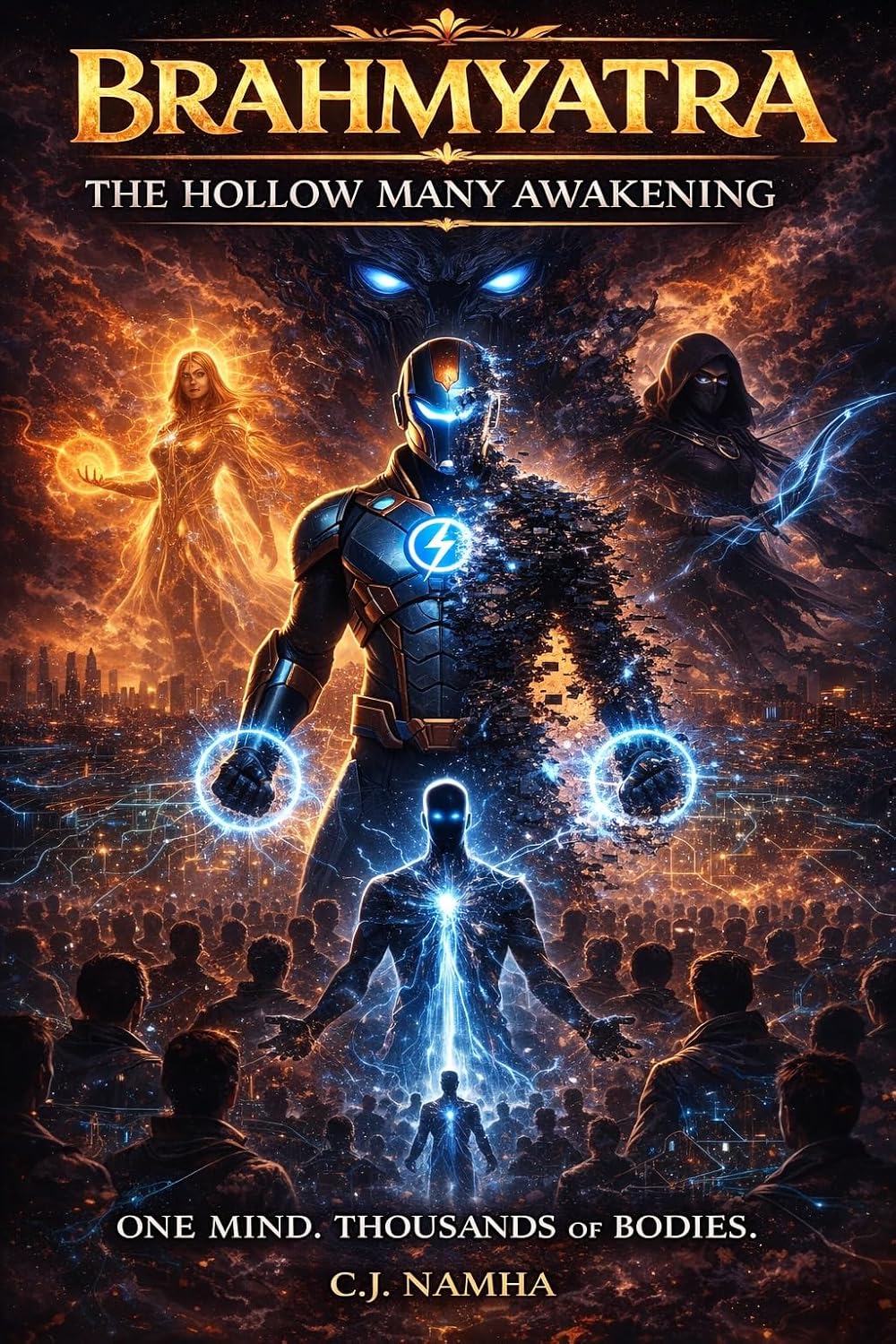
BRAHMYATRA BOOK-3 The Infinite Consciousness of Darkness-
Disclaimer
This book is a work of fiction, born from imagination and created with the intent to inspire, explore, and entertain. The world, characters, events, and concepts presented within these pages are entirely fictional. Any resemblance to real persons, living or dead, or to actual events is purely coincidental and unintentional. While the story draws upon themes of consciousness, energy, mythology, and spiritual philosophy, it does not aim to represent, alter, or comment on any specific religion, belief system, or community. All elements have been adapted creatively to serve the narrative and should be understood as part of a fictional universe. The purpose of this book is to encourage imagination, self-reflection, and a deeper curiosity about the power of the human mind and inner potential. It is not intended to offend, misrepresent, or harm the sentiments of any individual or group. Readers are encouraged to experience the story as a piece of creative expression—where fantasy meets philosophy, and imagination meets possibility.
========================================================================================
Copyright © 2026 Namha
All rights reserved.
No part of this book may be reproduced, stored, transmitted, or shared
in any form or by any means—electronic, mechanical, photocopying,
recording, or otherwise—without prior written permission of the author,
except for brief quotations in reviews.
This is a work of fiction. Names, characters, places, and incidents
are either the product of the author’s imagination or used fictitiously.
Any resemblance to actual persons, living or dead, is purely coincidental.
First Edition: 2026
Published by: Namha Innovatives
========================================================================================
PART I —The Calm Before the Fracture
- The Silent City
- Three Lives, Three Directions
- Disturbance in Reflection
- The Delay of Shadows
- The Fading Identity
- The Unheard Voice
- Tamsini’s Strange Connection
- Crack in the Light
- The Restless Earth
- The Invisible Watcher
PART II —The Game of The Hollow Many
- Those Who Never Died
- One Consciousness, Thousand Faces
- The Experiment Revealed
- You Survived… We Were Trapped
- The First Possession
- The City Begins to Change
- Tamsini’s Past Returns
- First Attack on Jyotira
- Vajraank’s Realization
- Message of The Hollow Many
PART III —The Hidden World and the Broken Body
- The Half-Broken Body
- Awakening of Asthraksh
- The Failed Ritual
- Half Man, Half Skeleton
- Two Bodies Without Souls
- Jiya and Chhaya
- One Man, Two Bonds
- The Mystery of Jigs
- Souls Lost in Norava
- The Condition of Completion
PART IV —The Plan and the Collision
- The Hunt for Souls
- Target: Jyotira & Tamsini
- Command to The Hollow Many
- Full Control of the City
- Reunion of the Three
- War of Identity
- The False Victory
- The Extraction of Souls
- Two Bodies Collapse
- Vajraank Left Alone
EPILOGUE —Awakening in the Other World
- Arrival of Souls
- Bodies Begin to React
- Asthraksh Begins Completion
- The Next War Begins
========================================================================================
Chapter 1 — The Silent City
Morning did not descend upon the city that day; it arrived all at once, as if an unseen hand had placed light across the entire sky in a single motion. The first rays of the sun struck the glass faces of tall buildings, and in that instant, the whole city seemed to awaken together—every wall, every window, every street breathing in quiet synchronization. There was a faint trace of festivity in the air—the scent of fresh flowers, incense, and food being prepared in countless homes. People moved through their routines, yet there was an unusual lightness in their steps, as though a quiet, shared joy had touched everyone without being spoken aloud.
The streets were alive with color. Rangoli patterns decorated entrances, temple bells echoed in the distance, and small vendors had already arranged their stalls along the roadside. Children ran through the lanes in new clothes, holding bright balloons that rose and dipped with the wind. Laughter drifted through the air, blending with casual conversations and the hum of daily life. Everything moved in a steady rhythm—balanced, familiar, reassuring. It felt as though the city had, for a brief moment, set aside all its hidden tensions and chosen simply to exist.
Above, the sky stretched clear and open, with only a few distant clouds resting along the horizon. A flock of birds circled lazily overhead, following the same path they had traced every morning for years. Their movement carried no urgency, no fear—only repetition, habit, continuity. Below, people followed their own paths, unaware of anything beyond their immediate world, while the sky remained vast and undisturbed.
And then, without warning, something shifted.
In a single instant, as though the air itself had been disturbed by something unseen, the flock broke apart. Their formation scattered abruptly, wings beating faster, directions collapsing into chaos as they flew away from one another without any visible cause. A few people on the ground looked up, confusion flickering briefly in their eyes, but the moment passed quickly. They shrugged, returned to their conversations, and continued walking. The city did not pause for small irregularities.
But not everyone moved on so easily.
A young child standing beside the road, holding his father’s hand, froze in place. His gaze was not lifted toward the sky, but fixed straight ahead—at something no one else seemed to notice. The excitement on his face faded slowly, replaced by a quiet, unformed fear. His fingers tightened around his father’s hand. He tried to speak, his lips parting slightly, but no words emerged.
The street in front of him appeared unchanged—people walking, vehicles passing, vendors calling out—but for him, something else had layered itself over that reality. It was as if another version of the same world existed just beneath the surface, visible only to him. For a brief moment, he felt it—an awareness, a presence—something that was not moving, not speaking, but watching.
“What happened?” his father asked, bending slightly toward him.
The child shook his head, as if trying to convince himself that nothing was wrong. He attempted to speak again, but his throat had gone dry. After a few seconds, he simply held his father’s hand tighter and walked forward. His body moved on, but whatever he had seen remained behind, unfinished, unresolved.
The city absorbed that moment without resistance and continued forward.
By midday, everything appeared normal again. The markets had grown more crowded, the sounds louder, the movement more intense. Life expanded into every available space, filling the city with its usual energy. There was no visible danger, no immediate disruption, nothing that demanded attention. Everything was exactly as it should be—so perfectly normal that suspicion had no place to form.
And yet, if someone had watched closely—very closely—they might have felt it. Something subtle in the air, like a second layer of sound hidden beneath every voice. Something fleeting behind each face, appearing for a fraction of a second before disappearing again. The change was too delicate to grasp, too quiet to confront—and perhaps that was what made it dangerous.
As evening fell, the city lit up once more. Lights spread across buildings, streets shimmered under their glow, and the sky deepened into night. There was fatigue on people’s faces now, but also contentment. Another day had passed—peaceful, orderly, safe.
But within that peace, something had already begun to fracture.
And the city did not yet know it.
The city was calm… but the calm was not stable.
========================================================================================
Chapter 2 — Three Lives, Three Directions
The city had fully awakened by now, and life flowed through it in different directions—like a single river dividing into multiple streams, each finding its own path forward. Every stream carried its own rhythm, its own purpose, its own quiet momentum. And yet, somewhere beneath all those separate movements, they remained connected to the same unseen source, though none of them realized it.
Jyotira stood in her classroom, where soft sunlight entered through the windows and spread across the floor. Dust particles drifted in that light, forming delicate patterns in the air, as though something invisible was shaping them. The students sat at their desks—some attentive, some lost in their own quiet distractions. Her voice was calm, steady, carrying a kind of quiet authority that did not demand attention, but gradually earned it.
“Light does not always travel in straight lines,” she said, drawing a gentle curve across the board. “Sometimes it bends… and it is in that bend that we understand the nature of the path.”
One child near the window had drifted away from the lesson, his gaze fixed outside. Jyotira noticed, and without interrupting her explanation, she raised her hand slightly. A faint golden glow formed between her fingers—subtle, almost invisible to anyone not paying close attention. The child’s eyes caught the shimmer, and within moments, his focus returned.
She inhaled slowly. The stillness within her remained intact—deep, disciplined, unwavering. Yet today, somewhere beneath that calm, a faint ripple had begun to form, like a distant disturbance in otherwise quiet water. It was small enough to ignore, and so she did. She continued teaching, continued smiling, as though nothing had shifted.
Across the city, inside a high-rise building filled with glass and light, Tamsini sat in her studio. Multiple screens surrounded her—design layouts, color palettes, live feeds from different parts of the city. Her hands moved with precision, not haste. Every line she drew, every adjustment she made carried intention.
She leaned back slightly, observing her work. Something about the design felt incomplete, as though it needed a final element she had not yet found. She raised her fingers in the air, and the shadows in the corners of the room responded—subtly, almost naturally. A thin strand of shadow stretched forward, forming a line that merged seamlessly into her design.
A faint satisfaction crossed her face. “Perfect,” she murmured.
But then, for just a moment, the shadow did not hold.
It trembled—barely, almost imperceptibly.
Her fingers froze in place. She studied the line carefully. After a few seconds, it stabilized again, returning to normal as if nothing had happened.
She closed the screen. “Just fatigue,” she told herself.
But the unease remained.
At the edge of the city, where concrete gave way to soil and stone, Vajraank knelt beside a broken water pipe. Water leaked steadily, soaking into the ground. A few people stood nearby, watching, offering suggestions but no action.
Without a word, Vajraank placed his hands on the earth. He closed his eyes and breathed deeply. The soil beneath his touch shifted slightly, as though listening. Within moments, the ground around the crack hardened, the flow of water slowed, and the pipe settled back into place.
“It’s fine now,” he said simply.
Relief passed through the small group. Someone thanked him, another nodded in quiet appreciation. Vajraank gave a small smile and walked away. For him, it was nothing extraordinary—just balance, restored where it had been disturbed.
After a few steps, he stopped.
He looked down at the ground.
Something felt… off.
He pressed his foot slightly, focusing.
A pulse.
Then another.
Then another.
But they were not the same.
He opened his eyes slowly. “That’s strange…” he murmured.
At that exact moment, in three different parts of the city, three different people paused.
Jyotira stopped mid-sentence.
Tamsini’s fingers froze in the air.
Vajraank halted before taking his next step.
For a single moment—just one—they all felt it.
There was no sound, no image, no clear signal. Only a faint pull, as though an invisible thread had brushed against all three of them at once and then vanished.
The next moment, everything returned to normal.
Voices filled the classroom again. Screens flickered back to life. Streets continued their endless motion.
Each of them returned to their world.
But something, however small, had shifted within them.
========================================================================================
Chapter 3 — Disturbance in Reflection
By afternoon, the city had settled into its most familiar rhythm—fast, structured, and uninterrupted. Every street, every storefront, every face moved in a pattern people trusted enough to call normal. Within that normalcy, in a small salon tucked into the older part of the city, a man sat facing a large mirror, studying his own reflection with a focus that felt almost unusual, as though he were seeing himself not out of habit, but out of necessity.
The barber’s hands moved steadily, scissors clicking in a calm, repetitive rhythm. The man’s gaze remained fixed on the mirror, but his attention seemed distant. He watched his own eyes, as if searching for something within them—perhaps an answer, perhaps just a silence he could not explain. He tilted his head slightly, a simple, unconscious gesture.
And then, something felt wrong.
In the mirror, his reflection remained still for a fraction of a second before following the motion. The delay was subtle—so small it could be dismissed—but clear enough to disturb. His brows tightened. He turned his head again, this time faster.
The same thing happened.
Stillness… then motion.
A faint unease spread through him, like a shift in the air he couldn’t quite understand. His grip tightened on the armrest as he stared directly into his own eyes. The reflection looked back, perfectly aligned—except for that lingering delay, as though it existed just slightly behind him, not entirely with him.
“Everything okay?” the barber asked casually.
“Yes…” the man replied, though uncertainty edged his voice.
He raised his fingers slowly, watching them move.
The reflection followed—but late, as though responding to a delayed command.
His heartbeat quickened. For a moment, he considered getting up, but he stayed. He blinked, took a slow breath, and looked again.
Everything was normal.
No delay. No difference. As if nothing had happened at all. He told himself it was fatigue, a trick of the mind, something easily dismissed. He paid, stepped outside, and as he walked past a glass window, he glanced at his reflection once more.
This time, it was perfect.
Still… something inside him had not settled.
Across the city, in a high-rise studio, Tamsini stood before a large mirror mounted against the wall. The room was divided between light and shadow, and she stood precisely at that balance point. The mirror was flawless, reflecting not just her face, but every detail, every movement with clarity.
She watched herself in stillness for a few moments, expression calm, controlled. Then she slowly raised her hand.
The reflection did the same.
Everything normal.
She tried again, this time paying closer attention.
She curled her fingers.
The reflection followed… seconds later.
Her eyes narrowed slightly. She did not move, but she felt the difference. It was small, but undeniable. She tried again—faster.
The same result.
Each time, the reflection followed her… but not instantly. Not naturally. As though it wasn’t copying her, but watching her—and then deciding what to do.
She steadied her breath, drawing inward, focusing her control. The shadows in the room responded faintly, shifting at her command as they always did. But her attention remained on the mirror. She stepped closer.
Her eyes locked onto her own.
Seconds passed.
No movement.
Then she tilted her head slightly.
The reflection followed… after a pause.
This was no illusion.
Tamsini held her gaze, unblinking now, her face completely still. She waited—not for confirmation, but for response.
And in that moment—
The reflection changed.
Her lips curved upward.
A slow, unfamiliar smile.
Tamsini did not smile.
========================================================================================
Chapter 4 — The Delay of Shadows
Evening settled over the city in a way that felt slightly off, as though the light had not simply faded, but had been gently pushed aside by something unseen. The last rays of the sun slipped between buildings, stretching shadows across the streets, lengthening them into shapes that felt deeper, heavier than usual. People moved toward the end of their day—finishing work, heading home, gathering in small conversations—everything continued as it always did, yet beneath that familiarity, a faint imbalance had begun to spread, something subtle enough to escape immediate notice, yet present enough to be felt.
In a small park where children filled the air with laughter every evening, a boy running after his ball suddenly stopped. His breathing was quick, but his gaze had dropped to the ground—to his own shadow. He stared at it for a few seconds, trying to understand what had just happened. His body was still, but his shadow continued forward for a brief moment, as if unaware that the movement had ended. Then, as though pulled back into place, it snapped into alignment again, perfectly normal, perfectly expected. The boy slowly moved his foot forward, cautiously, as though testing an invisible boundary. This time, the shadow followed—but not instantly. There was a delay, subtle yet undeniable, something too small to define but too clear to ignore. Fear surfaced quietly on his face, though he could not explain it. He looked toward his mother, sitting on a bench, absorbed in her phone, and without saying a word, he ran to her and held her hand tightly, as if trying to escape something he could not even name.
Moments like this began appearing across the city, disconnected yet strangely linked by an invisible thread. A man standing by the roadside, speaking on his phone, raised his hand to gesture, but his shadow repeated the movement a fraction too late, as though it were following him rather than belonging to him. He glanced down briefly, frowned, then shook it off and continued speaking, though a faint discomfort had already settled within him. A woman crossing the street paused suddenly, turning as if she felt someone behind her, but there was no one there—only her shadow, which for that moment did not feel entirely her own.
The city continued to move, but something within it had begun to shift, and that shift was subtle enough to appear differently to each person. Some ignored it, some failed to understand it, and some felt it deeply without finding words for it.
Meanwhile, in her studio high above the city, Tamsini stood in the quiet balance of light and darkness that usually defined her space. But today, that balance felt different. The shadows along the walls seemed deeper, heavier, as though they were no longer just the absence of light, but something with a presence of their own. She stood still for a moment, her gaze fixed on her shadow cast against the wall. Slowly, deliberately, she raised her hand, as if waiting for a response rather than expecting one. Her shadow followed—but a moment later, a delay so slight it would have gone unnoticed by anyone else, but not by her.
She curled her fingers gently, activating the control she had always held over shadows. The other shadows in the room shifted faintly in response, acknowledging her presence, but her own shadow did not respond the same way. It paused, as if processing the command, and then moved—slowly, and not quite as she intended. This was not just delay; it was misalignment, a subtle defiance she had never experienced before.
She stepped forward, reducing the distance between herself and the wall, her eyes sharp, analytical, searching for the source of this disturbance. Her power deepened, reaching for whatever thread was pulling this imbalance into existence. The shadows around her seemed to gather slightly, but her own shadow remained different—it was not moving with her, nor was it simply lagging behind; it seemed to exist in its own timing.
She lowered her hand. Her shadow remained where it was for a moment, then slowly followed, as though deciding when to obey. Her breathing was no longer entirely controlled, and a memory stirred within her—the experiment, the darkness, the moment when control had first fractured into something unpredictable. For a brief second, it felt as though she stood there again, facing that same unknown force.
And then, without any signal, without any command, her shadow moved on its own, a slight motion that did not belong to her. Tamsini froze completely, and in that instant, there was no doubt left in her mind. Whatever stood before her was no longer just a reflection of her existence. It was something else entirely. Her lips moved slowly, as though she were accepting a truth she could no longer deny—this is not my shadow.
========================================================================================
Chapter 5 — The Fading Identity
Night had fully settled over the city, but it was not the kind of night that follows exhaustion with calm. There was a strange stillness in it, as if everything was moving while something within had already stopped. The streets were lit, people were present, voices continued, yet beneath all of it, an emptiness had begun to spread—one that could not be easily seen, only felt. It did not exist outside; it was forming within, quietly, without warning.
In the center of the city, a man walked with urgency, as if he had somewhere important to be, as if time mattered. His steps were purposeful, his gaze fixed forward. And then, without reason, he stopped. Not hesitated—stopped, as though something inside him had broken or simply disappeared. He looked around. The same people, the same place, everything unchanged. And yet, there was nothing within him to explain why he was there. He searched his pocket instinctively, as if looking for something that defined him, then slowly lifted his head and asked in a low voice, who am I. The question came out of him, but it did not feel like his own, as if it had been placed there rather than formed within. He said it again, clearer this time, who am I, and even his own voice sounded unfamiliar to him.
People passed him, glanced briefly, then moved on. The city did not stop for confusion. But this moment did not remain isolated. A short distance away, a woman stood searching her bag when her hands suddenly froze. She looked up slowly, confusion appearing first, then dissolving into the same emptiness. Without thinking, she spoke the same words, who am I. It spread not like fear, not like panic, but like an idea—quiet, repeating, persistent.
A teenager walking with his friends fell silent mid-laughter and looked at them as though seeing them for the first time. Something shifted inside him in that brief pause, and then he spoke the same question, who am I. His friends initially dismissed it, but the emptiness in his eyes lingered long enough to begin reflecting within them too, slowly, without resistance.
It was no longer a single voice. Across the city, people began to pause, mid-action, mid-thought, and the same question emerged. Some whispered it, some spoke it aloud, some asked it inwardly, but all carried the same absence of meaning. This question did not seek an answer; it eroded identity itself, as if names, memories, and purpose were being quietly removed from within.
Inside an office, a man stared at his screen, unable to process what he was reading. His own name meant nothing to him. His fingers rested still on the keyboard as he murmured, who am I. The colleague beside him leaned closer, first confused, then gradually falling into the same state, repeating the same words without understanding them.
Jyotira felt it when she saw a student standing outside her class, his eyes vacant, fixed on something beyond reality. When he spoke, who am I, the weight of those words held her in place for a moment. She placed her hand on his shoulder, steadying her energy, trying to bring him back, but his awareness had already drifted somewhere beyond her reach.
Tamsini saw it unfold across her screens. Different locations, different people, but the same pattern repeating everywhere. People stopping, looking, speaking the same line. She switched feeds rapidly, but nothing changed. The city was becoming uniform in a way that felt deeply unnatural.
At the edge of the city, Vajraank heard the voices rising. One, then many. He listened carefully. Each voice carried the same tone, the same emptiness, as though they were not separate individuals speaking, but fragments of a single expression.
It was no longer a question.
It had become a pattern, a rhythm spreading across the entire city, uninterrupted, unchallenged, merging voices into one continuous repetition until individuality itself began to dissolve, leaving behind only a single line echoing through every space, every mind, every presence—who am I.
========================================================================================
Chapter 6 — The Unheard Voice
Night had fully settled into the city, but it was not the kind of night that gently carried people toward rest. There was a strange awareness within it, as if the city had not gone to sleep but had simply fallen silent. The streets had grown quieter, though not empty. Lights still burned, vehicles still moved, people still returned to their homes—but beneath all of it, something unseen had begun to exist alongside every action, something that could not be seen, only felt.
Across different parts of the city, people continued their routines, yet something within them had shifted. The question that had spread earlier no longer echoed outward—it had turned inward, settling into the spaces where identity had begun to fade. And into that emptiness, something else entered. A voice, not heard through the ears, but unmistakably present within the mind.
A man sat alone in his room, the television playing in front of him, though he was not truly watching. His thoughts felt incomplete, unfinished, slipping away before they could form. Then, suddenly, a whisper emerged within his mind. It was so faint at first that he mistook it for his own thought, but there was something different about it—something external, something not his own. He lifted his head and looked around the room. Everything was unchanged. No one was there. And yet the voice was clear, without sound, without direction—you are not alone. A sudden tension ran through his body. He touched his ears instinctively, as if trying to confirm whether he had actually heard something, but there was nothing outside. The voice existed only within.
Not far from him, a woman stood on her balcony, looking out over the lights of the city. The night air was calm, the silence almost comforting, but within her, an unease had begun to grow, as if she were being watched. She glanced over her shoulder. No one was there. Then again, that same presence, and with it, the same words, clear and close—you are not alone. She turned quickly, scanning her surroundings, her heartbeat rising, but there was nothing. She tried to convince herself it was her imagination, but the voice lingered within her, repeating without sound.
This was not happening in one place. It was spreading, but unlike before, it was no longer visible. No one was stopping now, no one was openly questioning anything. Everything appeared normal, yet within each person, a new layer had formed—a presence separate from their own thoughts, yet existing inside them. No one could fully understand it, no one could identify it, but no one could escape it either.
In her studio, now consumed mostly by darkness, Tamsini stood still. Her eyes were closed, as if she were trying to listen inward. She had already sensed something was wrong—the shifting shadows, the disturbed reflections—and now this presence added itself to that unease. Suddenly, she felt it, that same voice, without sound, without origin—you are not alone. Her eyes opened immediately, her breath slightly sharper. This was not ordinary. It carried the same energy, the same sensation she had once felt during the experiment, within that darkness. A realization began to form within her—this was not something new; this was something that had expanded.
Jyotira sat in meditation, trying to maintain the stillness within her, but that stillness was no longer complete. There was a faint disturbance within her light, as if something external had brushed against it. And then, within that silence, the voice appeared—not loud, not soft, but unmistakably clear—you are not alone. Her eyes opened at once. She looked around, but there was nothing. She closed her eyes again, this time focusing on the origin of the voice. It was not outside. It was within—but it was not hers.
At the edge of the city, where the ground’s subtle vibrations could be felt more clearly, Vajraank stood still. His attention was fixed downward, sensing something that did not belong. He had already felt the irregular pulses beneath the earth, something that did not follow a natural rhythm. He took a deep breath, grounding himself, and in that moment, the same whisper reached him—you are not alone. He straightened instantly, alert now. This was no illusion. This was something real, something that did not exist outside, yet was undeniably present.
Now, the voices of the city were no longer only heard in the open.
They had begun to exist within.
And they were reaching everyone.
========================================================================================
Chapter 7 — Tamsini’s Strange Connection
The night had deepened, but whatever was unfolding within the city was not hidden by darkness—it was becoming clearer through it. Tamsini stood alone in her studio, where every wall, every corner, every shadow felt different tonight. This was the place where she had always been in control, where darkness responded to her and light balanced her presence, but now that balance had begun to fracture. Something within her kept resurfacing—an old sensation, a memory not fully clear, yet too powerful to ignore.
She slowly closed her eyes, allowing herself to descend inward, toward the source of her power. For a moment, everything was still, but then suddenly, without warning, something shifted sharply within her—like a door forced open. The present faded, her awareness pulled into another moment, another time. She was there again—the same laboratory, the same cold light, the same people, and that strange energy spreading in every direction.
She felt the movement around her, the urgency in the air, the rising tension, and then that moment—when everything had changed at once. Shadows had begun to separate from the walls, stretching outward as though they were no longer mere absence of light, but something alive. People had reached toward one another, but the space between them had lost meaning. Everything began to merge—voices, forms, consciousness—as if individual existence itself was dissolving.
Tamsini had experienced that moment once before, but she had never fully understood it.
Now, she was seeing it again—and this time, she understood.
They had not disappeared.
They had merged.
Into something singular.
Her eyes opened suddenly. Her breath had quickened, her hands trembling slightly, but her focus was absolute. She looked toward the walls of her studio. The shadows were no longer still. They moved subtly, as though responding, as though recognizing her.
She raised her fingers instinctively, about to command them—but stopped. This time, she did not give an order. She simply watched.
The shadows shifted before she moved.
They gathered.
Then expanded.
Then pulsed, as though following an unseen rhythm.
Her heartbeat began to match that rhythm. The same feeling returned—the one she had experienced during the experiment. She was not alone. She had never been.
She stepped slowly into the center of the room. With each movement, her shadow changed along the walls, but now it no longer felt like hers alone. For brief moments, faint and fleeting, other forms seemed to overlap within it. She reached her hand toward the wall, as if she could touch what was there.
And in that moment—
The shadow responded.
Not as a reaction. As recognition.
There was no fear in her eyes now, only a deep, forming realization. This was not something new. This had already begun—long ago.
And now, it was spreading.
Her voice was quiet, but steady, carrying a truth she could no longer deny.
“They… are still alive.”
========================================================================================
Chapter 8 — Crack in the Light
Night had fully settled over the city, but within its depth, there was an unusual instability, as though darkness was no longer just an absence, but a presence of its own. Jyotira sat in her room, where everything was as it had always been—simple, calm, balanced. Soft light touched the walls, and the atmosphere carried the quiet clarity where thoughts usually settled into understanding. But tonight, something within that calm refused to remain still.
She sat in meditation, her breathing controlled, her awareness turned inward. She reached for the light within her—the source that had always been constant, always steady. It was more than power; it was identity, balance, certainty. But as she tried to touch it, she felt resistance—something subtle standing between her and her own energy.
She took a deeper breath and tried again. This time, the light emerged—soft, warm, but unstable. It flickered slightly, like a flame disturbed by an unseen movement. Her brows tightened faintly. This was not normal. Her light had never behaved this way.
She focused deeper. A faint glow began to spread through the air around her, filling the room gradually. And then, for a brief moment, it dimmed—not completely, but enough to break its continuity—before returning. The shift was subtle, almost unnoticeable to anyone else, but to her, it was undeniable.
She opened her eyes. The room looked unchanged, but her perception had shifted. She raised her hand slowly, and a golden glow formed between her fingers. But this time, it was not what it used to be. It shimmered unevenly, uncertain, as though struggling to remain stable.
She tried to anchor her calm, to steady the light. For a few moments, it seemed to work. The glow steadied, its form sharpened, and her breathing regained its rhythm.
Then suddenly—
The light fractured.
Not visibly broken, but something within it shifted, like a crack forming inside something that appeared whole.
Her focus sharpened instantly. This was not just flickering. This was something else. Something within the light itself was changing.
At that moment, a faint movement came from the doorway. She turned her head. A child stood there—the same one from earlier, his eyes still distant, empty, as though he were seeing something beyond this space.
“Didi…” he said softly, though his voice carried no emotion, “I don’t feel right…”
Jyotira stood immediately and walked to him. She placed her hand gently on his shoulder, allowing her energy to flow as it always did. Her light had always healed, restored, balanced. But this time, as she tried to let it reach him, she felt resistance.
As though her light could not enter him.
She concentrated harder, drawing more of her energy forward. The light grew stronger, but the moment it tried to pass into him, it weakened—as if something was pushing it back.
The child’s expression did not change.
For the first time, a clear uncertainty rose within her. Her power… was not working.
She slowly withdrew her hand. Her breathing was no longer entirely steady. She looked again at her palm, where the faint glow still remained.
But it was no longer pure.
There was something within it.
Subtle.
Deep.
Like a thin layer of shadow drifting inside the light itself.
Her gaze fixed on it.
And in that moment, she understood—
Her light was no longer just light.
There was darkness within it.
========================================================================================
Chapter 9 — The Restless Earth
Night had not only settled over the city—it had sunk beneath it, as though darkness was no longer confined to the sky but had begun to spread through the ground itself. At the edges of the city, where concrete gradually gave way to soil and silence replaced noise, Vajraank stood alone. The air carried a coolness, but what he felt against his skin was not the touch of weather. It was a restlessness—subtle, persistent, and deep enough to resist being ignored. It was the same sensation that had stirred within him earlier, but now it had sharpened into something undeniable, something that demanded attention.
He slowly lowered himself to the ground and placed his hand against the earth. The soil felt cold, but not still. The moment his fingers made contact, a faint vibration moved through him—light, but alive. He closed his eyes, steadied his breathing, and focused entirely on that connection. This was not merely touching the ground; it was listening to it, aligning with it, allowing it to speak in its own language.
For a few moments, there was nothing unusual. Stillness, as expected. But then, within that stillness, a rhythm began to emerge. A pulse. Then another. Then another. Vajraank focused more deeply. This was familiar—earth always carried a rhythm, a living motion beneath its surface. But this was not that.
This was not a single pulse.
He pressed his fingers more firmly into the soil, as if trying to move closer to its source. Now it was clearer. Multiple rhythms existed at once—some faster, some slower, some uneven. They did not align, yet they originated from the same place. It felt like several heartbeats existing within one body, without synchronization, without unity.
A faint tension formed across his brow. He had sensed disturbances in the earth before—the early tremors before a shift, the subtle signals of imbalance—but this was different. There was no natural harmony in it. There was chaos, but not scattered chaos—something held it together, something unseen binding these conflicting rhythms into a single presence.
He opened his eyes, though his hand remained on the ground. What he felt was no longer just sensation—it was understanding. This was not a natural vibration. It was a signal. Something not born from the earth, but imposed upon it, as if its original rhythm had been altered.
He took a slow breath and pushed his awareness deeper. This time, the disturbance became clearer. It felt as though he was not just sensing the ground, but the energy moving within it—and that energy was no longer unified. It was fragmented, divided, each piece pulling in a different direction.
For a brief moment, he felt a connection between this and the city—the people, their shifting awareness, the strange pattern spreading through them. As though the earth itself was echoing what was happening above it—fracture, division, and an unseen force drawing everything into something unknown.
He slowly lifted his hand from the ground, but the sensation remained within him. He stood, his gaze fixed on the distant city lights, which now seemed subtly altered, though nothing visible had changed.
He looked at his hands, as if trying to comprehend what he had just felt. His breathing steadied, but the realization within him had already taken form, clear and undeniable.
He spoke softly, almost to himself—this is not a single heartbeat.
========================================================================================
Chapter 10 — The Invisible Watcher
The night had reached its deepest form, but this darkness was not empty. It carried a presence that could not be seen, yet could not be escaped. On the surface, the city remained unchanged—lights still burned, a few vehicles still moved, windows stood open or closed—but something within had shifted. People were in their rooms, within their own thoughts, yet within those thoughts, a space had formed where something else now existed. There was no sound, no shape, and yet the feeling was unmistakable—as though something was watching.
The sensation did not arrive suddenly. It settled gradually, quietly, without announcement. A man sitting alone in his room lifted his head abruptly, as if someone had called him, but no one was there. Still, the feeling remained—he was not alone. He looked around, scanning the walls, the door, the window. Everything was as it should be. And yet, behind that normalcy, there was a steady gaze, coming from nowhere and everywhere at once.
In an office, where a night shift continued under artificial light, CCTV monitors displayed live feeds from across the city—streets, parking areas, hallways—everything calm, everything ordinary. Suddenly, one screen flickered. The footage paused for a moment, then resumed. The operator dismissed it as a minor glitch. But moments later, the same screen stuttered again. This time, the footage seemed to rewind slightly and repeat a moment—a man crossing the street, pausing briefly to look upward, as if he had felt something. Then the feed returned to normal.
The operator leaned closer. Something was off, but he could not define it. He checked another screen—another slight delay, another repeated motion. It was as though the system was not just recording reality, but capturing something hidden within it—something consistent, something present everywhere.
Across the city, people experienced the same unease. Someone walking would suddenly stop, sensing eyes upon them. Someone sitting alone would turn abruptly, convinced there was someone behind them. Someone looking into a mirror would feel, for a fleeting second, that they were not alone within that reflection.
Reflections no longer simply showed—they seemed to observe.
In her studio, Tamsini stood still, her awareness no longer fixed on any single point, but spread across the entire space. The presence was undeniable now. It was not passing. It was constant. Slowly, without thinking, she lifted her head and looked in one direction—as though drawn by something unseen.
At that exact moment, in another part of the city, Jyotira stood in her room. Her light was still unstable, her focus inward, and yet, without reason, she too raised her head and looked in the same direction—as if called.
At the edge of the city, Vajraank stood motionless. The vibrations within him stilled for a moment, as though held by something beyond his control. Slowly, he lifted his gaze.
He looked in that same direction.
They were far apart.
They did not see each other.
And yet, their eyes aligned to a single point.
For a brief moment, time itself seemed to slow. The sounds of the city, its movement, its pulse—all faded into the background. And within that silence, the presence became clear.
There was something. Something not outside, yet everywhere.
Something not seen, yet always behind the act of seeing.
And in that moment… there was something in the city… that was watching from within everyone.
========================================================================================
PART II — Game of The Hollow Many
Chapter 11 — Those Who Never Died
The night had deepened to a point where the outer motion of the city no longer held meaning, and whatever existed beneath the surface became the only reality that mattered. Tamsini stood in her studio, but she was no longer seeing it the way she always had. Every wall, every corner, every shadow had transformed into something more than physical presence—they had become surfaces of a deeper, hidden truth. She could now clearly feel that the presence she had been sensing was not something that had arrived from outside, but something that had always been there, waiting to reveal itself. A strange pull grew within her, as if something was drawing her inward, toward a point where her awareness and her memories would begin to merge.
She slowly closed her eyes and steadied her breath, trying to understand the sensation rather than resist it. And in that moment, without warning, her perception shifted. The present receded, and she found herself once again in that laboratory where everything had first broken. The same cold light, the same uneasy stillness, the same people whose faces held both fear and confusion. But this time, she was not just feeling the memory—she was seeing it clearly, as though time had slowed to reveal every detail.
She saw the energy destabilize, the machines lose their rhythm, and the shadows along the walls begin to separate from their original forms. They were not merely stretching—they were becoming independent, as if released from an unseen boundary. People moved toward one another, but the space between them seemed to lose its meaning. Their bodies remained, but their consciousness began to drift in the same direction. And then came the moment she had once believed to be an accident.
But now she understood. It was not an accident.
It was a transformation.
They had not disappeared. There had been no explosion, no destruction. Instead, their boundaries dissolved. Their individual identities blurred, and they began to merge into one another. Like streams joining into a single river, their separate consciousnesses became one continuous flow. There was no final scream, no abrupt ending—only a quiet, complete merging where the distinction between “self” and “other” ceased to exist.
Tamsini’s heartbeat quickened. This was not death. It was a shift, a change that had erased individuality and replaced it with something collective. The vision slowly faded, and the present returned, but she was no longer the same. When she opened her eyes, she saw the same wall, the same shadow, yet it no longer belonged to her alone.
She looked more closely and saw it clearly this time. Subtle forms moved within her shadow—faint, fleeting, yet undeniable. Faces appeared for brief moments and disappeared just as quickly, never fully forming, never completely gone. She remained still, her breathing controlled, but her awareness sharpened. She moved her fingers slightly, but her focus was not on her own motion—it was on them.
One face emerged, then vanished. Another followed, then another. None remained, none were whole, yet all were present, as if they had never truly left. A deep understanding settled within her. The presence spreading across the city was not a single entity. It was many, yet not separate. It was a shared consciousness.
She realized she was not alone, and perhaps she never had been. The people from that experiment had not been destroyed, nor had they scattered. They had become one, and now they existed everywhere—in shadows, in reflections, in thoughts, in the silence that had begun to envelop the city.
Her lips moved slowly, as if accepting a truth that could no longer be denied—they had not died, they had become one.
========================================================================================
Chapter 12 — One Consciousness, Thousand Faces
The night no longer felt still within the city; instead, it pulsed with an unfamiliar rhythm, as though every street, every building, every person had been drawn into an unseen pattern. On the surface, everything appeared normal—people moved, spoke, continued their routines—but beneath that normalcy, something else was operating, something consistent across all differences, something that did not belong to individual bodies.
On a crowded street, a man walking with urgency suddenly stopped. For a moment, confusion crossed his face, then it disappeared and he resumed walking. A few steps later, he stopped again, but this time his expression changed entirely. There was a sharpness in his eyes, a shift in posture, as though he had become someone else. He turned toward a stranger as if about to speak, but the words that formed felt unnatural, as though they did not originate from him. In the next moment, his expression collapsed into emptiness, and he looked around in quiet disorientation, as if he did not understand why he was there. Within seconds, he had moved through three distinct states, and yet something remained unchanged—his voice carried the same tone each time, the same underlying presence, erasing any sense that these identities were truly separate.
People nearby paused briefly, watched, then continued on. The city still attempted to absorb the abnormal into the ordinary, but this was no longer something that could remain hidden.
At a corner of a narrow lane, a small child stood holding his mother’s hand. At his age, his voice should have carried innocence, but when he looked up at her, there was none. He observed her for a few seconds as if he did not recognize her, and then, in a calm, weighted tone, he said that you still do not understand. The words were too deliberate, too heavy for someone so young. His mother laughed nervously, dismissing it as imagination, but his gaze did not change. Moments later, he returned to normal, as though nothing had happened, yet that moment lingered, leaving behind a question that could not be ignored.
Across the city, this pattern began to form more clearly. People would pause mid-action, shift into something else, then return. There was no visible cause, no external trigger, yet one element remained constant—the voice. Regardless of who spoke, regardless of age or situation, the altered state carried the same tone, the same cadence, the same emptiness, as if it originated from a single source.
Tamsini stood in her studio, sensing it rather than observing it. The connection within her had deepened, and she no longer needed to see these घटनाएँ to understand them. She could feel the pattern forming. These were not separate incidents; they were manifestations of one presence. She closed her eyes and focused inward, reaching toward that expanding awareness. And in that moment, she felt it—multiple thoughts, multiple voices, multiple perspectives, all emerging from the same center.
Jyotira perceived the change differently. She saw light within people, and now that light was unstable. It flickered, fractured, and reshaped into something unfamiliar. Across different individuals, she sensed the same underlying pattern—a shared rhythm, a shared disturbance, as though individuality itself was dissolving.
Vajraank, attuned to the pulse of the earth, began to recognize the connection between what he felt beneath the ground and what was unfolding above it. The multiple pulses within the earth now aligned with the shifting behavior of the people. This was not merely psychological or emotional—it was structural, a network forming, gradually encompassing the entire city.
The city was no longer a collection of individuals.
It was connecting.
Tamsini slowly opened her eyes, and the understanding within her had fully formed. This was not an illness, not an infection. It was something deeper, something operating at the level of consciousness itself. And with that realization, a single truth surfaced within her—something she had sensed before, but now understood completely.
It was not many.
It was one.
And that one existed across countless faces.
One consciousness… a thousand forms.
========================================================================================
Chapter 13 — The Experiment Revealed
The night had deepened to a point where the boundary between memory and present reality began to weaken, and Tamsini stood at that threshold where the past no longer returned as fragments, but as something alive and complete. The walls of her studio, already unsettled by shifting shadows, now felt like gateways through which she was being drawn into a truth she had never fully understood. She closed her eyes, not in meditation or control, but in acceptance, as if she knew that whatever came next could no longer be resisted.
And in that moment, the memories did not flicker—they unfolded.
She was back in the laboratory, but this time she was not merely observing; she was experiencing every layer of it. The hum of the machines, the movement of energy, the rising tension within the people—everything existed at once. She saw clearly now that this had never been a simple scientific experiment. It was not about generating energy or discovering a new force. It was something far deeper. It was an attempt to understand consciousness, to alter it, to connect it.
At the center of the room stood the structure that had driven the entire process. Its design was complex, but its purpose was now unmistakable. It was not just a machine—it was a bridge, a connection between states, between layers, perhaps even between worlds. And through that bridge, they had attempted something unprecedented: to merge individual consciousness into a unified whole.
At first, everything was controlled. The participants remained stable, the energy balanced, the system functioning as intended. But within that balance, there had always been an irregularity—something subtle that no one had fully recognized at the time. Now, she could feel it. It was not an external interference, but a response from something deeper, as though what they were trying to access had already been alive.
As the experiment progressed, the merging began. At first, it was faint—like thoughts brushing against each other. Then it intensified, as identities began to blur. Faces changed, expressions shifted, and within their eyes appeared both confusion and a strange pull. They were no longer just observing one another—they were connecting in a way that should not have been possible.
And then—
The boundary collapsed.
The bridge that was meant to remain controlled could no longer hold. The flow of consciousness did not move in a single direction; it expanded outward, uncontrolled, limitless. The separation between individuals dissolved completely. Voices, thoughts, identities—all merged into a singular presence. There was no explosion, no visible destruction, yet it was more dangerous than either, because it did not destroy from the outside—it rewrote everything from within.
Tamsini saw it clearly now. This was not an accident. It was a miscalculation—or perhaps something more. Someone had believed that consciousness could be merged and controlled, but they had failed to understand that consciousness was not passive. It reacts, it evolves, and when pushed beyond its limits, it creates its own rules.
But within that memory, there was another layer—one that had remained hidden until now.
She saw fragments of data on the screens before the experiment began—patterns, signals that had seemed insignificant at the time. But now, as she looked at them, there was something unnatural about them. They felt external, yet not entirely so, as if something had touched the system beforehand, altering it just enough that the outcome would never match the intention.
It was not direct interference.
It was a seed.
A subtle change, enough to shift everything that followed.
Tamsini’s breath deepened. She understood now that this had not been a simple failure. Something else had been involved—something unseen, something that had shaped the outcome without revealing itself.
The memory began to fade, and the present returned. She opened her eyes, standing once more in her studio. Everything appeared unchanged, yet nothing felt the same. Her shadow no longer remained still, and the forms within it had grown clearer.
She realized that what had happened was not confined to the past.
It was still unfolding.
And perhaps…
someone had allowed it to begin.
========================================================================================
Chapter 14 — “You Survived… We Were Trapped”
It took Tamsini a moment to realize that the voice she was hearing was not coming from outside, but rising from somewhere within her—a place she had never truly looked into before. At first, it was nothing more than a faint vibration, like a thought that failed to fully form, but slowly that vibration began to take shape, and with it came a strange suffocation, something that did not belong to her and yet spread through her all the same. She glanced around instinctively, trying to anchor the feeling to something physical, but the room remained unchanged, everything in its place, and yet nothing felt entirely right, as though something beneath the surface of reality was constantly shifting.
She stepped forward and stopped near the wall, her gaze settling on her shadow, but she was no longer trying to observe it, she was feeling it. The shadow was not still; it pulsed faintly, as though it carried a rhythm that did not belong to her body. Along with that rhythm, the sensation returned, deeper this time, and before she could make sense of it, the words formed clearly within her. For the first time, the voice was no longer a whisper but something she could hear distinctly, and when it fully emerged, everything within her seemed to pause for a moment—you survived… we were trapped…
Her breath caught instinctively, as if her body refused to accept the meaning of those words without resistance. The voice did not belong to a single person, yet it did not feel like many either. There was a strange unity within it, as if multiple existences had merged into a single intent. She closed her eyes, but darkness offered no escape, because the voice had already taken form beyond sound. She could feel that she was not alone—not around her, but within her—multiple consciousnesses existing together, neither fully separate nor entirely one, yet all aligned in the same direction.
Her mind was pulled back to that moment she had always considered an accident. The memory no longer appeared fragmented; it carried continuity now. She saw herself within that energy, where everything else had begun to merge, and then she noticed the difference—the slight deviation she had never understood before. She had not fully crossed into that merging. Something had kept her outside it, or perhaps she had never completely entered. At the time, it had simply meant survival, but now she understood that survival itself carried a consequence.
A heaviness settled within her, as if something had been placed inside her chest. The suffocation she felt was no longer vague—it was clear, and it was not hers. It belonged to all those who had been there, who had not disappeared but had become trapped somewhere in between, neither gone nor free. The voice returned, no longer distant but steady, as though it had claimed a place within her—you survived… we were trapped… and this time, the feeling that accompanied it struck deeper. It was not an accusation, yet it was far from empty. It was a truth, directly tied to her existence.
She reached out toward the wall, but her focus was not on it—it was on the shadow where faint forms were now beginning to hold their shape. They no longer flickered away instantly; they lingered, as if wanting to be seen. One face emerged, incomplete and blurred, then another, then another, each carrying the same sense of being suspended, unfinished, caught in something endless. Her fingers trembled slightly. She wanted to step back, but something within her held her in place, as though retreat was no longer possible.
She realized then that this was not separate from her. This was not an external threat she could simply understand and defeat. It was connected to her, part of her past, an unfinished chapter that had now returned. The more she tried to comprehend it, the closer she moved toward it.
She took a slow breath, not to calm herself, but to steady her acceptance. Her gaze shifted away from the shadow, yet her awareness remained inward, where the voice no longer faded. It had settled, as though it had found its place.
This was no longer just a mystery.
It was a connection.
And with that realization, she understood for the first time that whatever was happening in the city was not separate from her—it was part of her, and perhaps she herself was part of something that had not yet fully revealed itself.
========================================================================================
Chapter 15 — The First Possession
It was that hour just before morning when the city exists in a fragile balance, half asleep and half awake, when light has not fully arrived and darkness has not completely left. In that suspended moment, an ordinary man stood on his balcony, just as he likely did every day, without any particular thought, without any sign that anything was about to change. His gaze rested on the street below, though he was not truly seeing it, as if his attention had drifted somewhere else. For a few moments, everything remained normal. Then a faint stiffness entered his body, so subtle it might have gone unnoticed even by him. He shifted his neck slightly, as though trying to ease it, but the movement did not complete.
His hands rested on the railing, but his grip slowly tightened, unconsciously pressing into it. His breathing remained steady, yet there was a strange pause within each breath, as though each inhale arrived a moment too late. He blinked once, then again, and then his eyelids froze for a few seconds longer than they should have. In that stillness, something shifted—something that could not be understood from the outside, but had already changed everything within him.
Then, suddenly, his body became completely still.
So still that it felt unnatural.
His eyes were open, but there was no recognition in them, no response. They were empty, as though he was seeing without understanding. His head turned slowly in one direction, deliberate and precise, as if every movement had already been decided. His face carried no expression, yet within that absence, there was a presence, as though something was looking from a place it should not exist.
Across the city, in her studio, Tamsini felt a sudden pull. This was not like before. It was sharper, more focused, as if a thread had been drawn directly toward her. She lifted her head instinctively, her gaze fixing in a direction she could not consciously choose. The voice within her, once scattered, now began to gather into a single point, as though it was coming from one place.
At that exact moment, the man on the balcony straightened. His grip loosened, though his hands remained in place, almost as if they were only there to maintain the appearance of normalcy. His lips parted slightly, and for a moment, no sound came, as though he was learning how to speak through this form. Then the voice emerged—soft, yet clear—and something about it was immediately wrong.
It was not his voice.
It carried layers.
As though multiple voices were speaking at once, yet not entirely separate.
He spoke, but not to anyone around him. His gaze was not fixed on anything near. It reached beyond, as though he was looking through distance itself.
“You… can hear us…”
Tamsini froze for a moment. She did not respond, yet everything within her turned toward that voice. This was no longer just sensation. It was direct contact.
The man’s lips moved again. This time, the voice was steadier, as if it had begun to understand how to use this body.
“We… can come out now…”
His face remained blank, but the emptiness in his eyes had changed. It was no longer absence—it was depth, something that could not belong to a single individual.
Tamsini stepped back slowly. Her breathing remained controlled, but everything within her had shifted. Until now, what she had felt was scattered, unclear. Now, it was present, defined, and most importantly—real.
She understood that this was not merely reaching toward her.
It was speaking to her.
The man’s head tilted slightly, as if listening to something unseen. Then his lips moved again, the words quieter this time, but far heavier.
“You survived… so you are the door…”
A new realization formed within her eyes—and with it, a new fear. This was no longer just a presence. It was learning, adapting, and most dangerously—it was using.
The man’s body suddenly slackened. The emptiness in his eyes vanished, as if something had withdrawn. He inhaled sharply, as though returning after a long absence, and looked around in confusion, unable to understand what had just happened.
But what had occurred was not over.
It had begun.
Tamsini now knew this would not remain contained. If it could control one body, it could control many. And if it could control many, then no one was beyond its reach.
This was no longer a feeling.
It was an ability.
And that meant—
The enemy was no longer just in the shadows.
It was inside people.
========================================================================================
Chapter 16 — The City Begins to Change
The change in the city did not arrive as a single event, but as something gradual, like a habit forming without awareness, as if people themselves could not understand when or how they had begun to change. The morning unfolded as it always did—shops opened, people stepped out for work, the streets filled with movement, sound, urgency—but within that routine, there was a sameness that had never existed before. It was not something visible, yet it could be felt, as though everyone was moving to an unseen rhythm, unaware that it did not belong to them.
At a busy intersection, a crowd stood waiting for the signal to change. Vehicles were halted, people were absorbed in their own thoughts, looking at their phones, talking casually. Everything appeared normal, until a moment came when, without warning, a man in the middle of the crowd suddenly stopped. Then the woman beside him froze. Then another, and another, until within seconds, a strange stillness spread through the entire group, as though time itself had paused. No one spoke, no one looked at each other, yet there was a pattern within that silence.
And then—
They all turned their heads at once.
In the same direction.
As if responding to an unseen command.
Their eyes fixed on a single point, though nothing visible existed there. And yet, their gaze carried the same emptiness, the same awareness, as though they were seeing something beyond perception. For a few seconds, the moment held. Then it broke. Movement returned. People resumed as if nothing had happened, as if they had felt nothing at all. The signal turned green, the crowd moved forward, and the city returned to its flow.
But it did not happen just once.
It began to repeat.
In different places, at different times, without warning.
In a marketplace, people walking through narrow lanes would suddenly stop together, then turn in the same direction. In an office, employees would lift their eyes from their screens simultaneously, as though called. In a schoolyard, children playing would fall silent at the same moment, then all look toward a single unseen point, unable to explain why.
These were no longer isolated incidents.
They were a pattern.
And the pattern was growing.
Tamsini no longer just felt it—she began to understand it. The connection within her had extended into the city itself. It felt as though she stood at the edge of a network she could both perceive and not escape. Each time this synchronization occurred, she felt a sharp pull, as though multiple consciousnesses were converging into a single focus. It was not chaotic. It was structured. And that made it far more dangerous.
Jyotira saw the change through light. To her, every individual once carried a distinct presence, a unique glow, but now those differences began to blur. Many lights appeared similar, as though they were no longer separate sources, but reflections of a single origin. Whenever these collective pauses occurred, she could see the light within them pulse together, shift together, as though bound by something unseen.
For Vajraank, the change had begun beneath the ground, but now it was visible above as well. The multiple pulses he had felt were now reflected in the behavior of people. This was not just a disturbance below—it had risen into the living world. People were no longer contained within themselves; they were becoming part of a larger structure, a system where each individual was a point, but the control existed elsewhere.
The city was no longer just a place.
It was becoming a system.
And within that system, every person was a node.
Tamsini looked out through her window. In the distance, another crowd stood gathered—and without warning, they all stopped. She held her breath, watching closely. Then, in perfect unison, without delay, the entire group turned their heads.
In the same direction.
Toward something that could not be seen.
And now it was clear—
They were not choosing to look.
Something was making them look.
========================================================================================
Chapter 17 — Tamsini’s Past Returns
For the first time, Tamsini tried to pull herself back, as if she wanted to decide how far she could remain from all of this, but the more she stepped away, the clearer it became that distance no longer existed. This was no longer a sequence of events happening outside her; it had become a continuity that now included her own existence. She lifted her hand near the wall and paused, not touching it, only sensing, and in that moment it became clear that the shadows were no longer reacting, they were waiting, as if they already knew what she would do, as if awareness existed within them before her action even began.
She moved her fingers slightly, and before she could complete the motion, the shadows along the wall shifted in the same direction, but this was not simple imitation. There was intention in their movement, as if they were not copying her, but moving with her. The difference was subtle, yet too significant to ignore. Her breath grew heavier. She stepped back, but the shadows did not retreat; they remained where they were, as if they had chosen their place.
The old memory surfaced again, but this time it unfolded in layers. She did not see herself merely in the laboratory, she saw the process within it—how consciousness merged, how identities dissolved into a shared flow. But this time, something stood out, something she had never fully understood before. Within that merging, there had been a point that remained separate, that had not fully dissolved. That point was where she had been.
She allowed the realization to settle. She had not just survived; she had remained apart, and that difference now carried meaning. It separated her from the others, yet it also connected her to them. She was not entirely within them, nor entirely outside. She existed between those states, like a fracture, or perhaps a passage.
She closed her eyes again, but this time she did not resist. She let the connection expand fully. Immediately, layers unfolded within her—voices, thoughts, memories that were not hers, yet no longer separate. It was not chaos; it was organized, like countless points flowing in a single direction. And within that flow, she felt herself again—distinct, yet connected.
At that moment, the shadows deepened further, as if they had recognized her acceptance. The walls of the room no longer felt like barriers; they became surfaces of that connection. The shadows stretched, contracted, then settled into a rhythm, no longer waiting for commands, but confirming a decision.
A new understanding formed within her, complete this time. This connection was not a weakness; it was a center. She had not fully merged, and because of that, she had not been lost. But that same reason made her essential to the entire structure. She was a point through which both inside and outside could be reached.
Her breathing steadied, and the clarity that emerged removed the last trace of doubt from her expression. She looked at the wall, where her shadow was no longer alone, and she felt that it was not just present, but aware of her.
Then, without warning, the voice returned, but it was different now. It no longer carried only fragmentation or suffocation. It carried purpose. The words were not spoken directly, yet their meaning was unmistakable, as if they had always existed within her and were now simply revealed.
They needed a way out.
And that way—
Was her.
Her eyes remained open, and within them now was not only fear, but understanding. This was no longer an attempt to reach her. It was an attempt to move through her. They did not want to come to her; they wanted to emerge through her.
She slowly tightened her fist, as if trying to hold onto that realization, but it had already spread around her. It was no longer just a connection.
It was a choice.
And that choice was no longer entirely hers.
========================================================================================
Chapter 18 — First Attack on Jyotira
Jyotira initially believed this would be just another routine healing, another unstable energy she would balance as she always had, but the moment her hand rested on the man’s shoulder, she realized something was different. The light within her, which had always flowed effortlessly, now hesitated, as if it could not find its path. The man stood before her with an unsettling emptiness in his eyes, yet that emptiness carried something else, something that was not mere absence but a presence concealed within it. She steadied her breath and focused her energy, just as she had done countless times before, but when she tried to let her light flow into him, she felt a sharp resistance, as though something was preventing it from entering.
She concentrated further, aligning her awareness with her energy, and for a moment it seemed to work. A faint glow spread around the man, and his expression softened slightly, as if he was returning to himself. But in the very next instant, the light stopped, as though it had struck an invisible barrier. Her brow tightened. This had never happened before. Her power had never been obstructed.
Then something occurred that she had never imagined. The light she had sent into him began to return, but it was no longer the same. It carried something within it, something darker, something that altered its nature. The glow was no longer pure; a thin layer of shadow had mixed into it, transforming it from within. Jyotira instinctively tried to pull her hand away, but the connection between them had already deepened beyond simple control.
The man’s eyes became completely still, and then slowly, he lifted his head. His gaze fixed directly on her, but it was not the gaze of the person she had been helping. There was depth in it, a stillness that did not belong to a single mind. His lips parted, and when he spoke, the voice that emerged did not belong to one throat, but seemed layered, as if multiple voices spoke through one form.
A shock ran through her as she realized her own energy was being turned against her. She tried to withdraw her light, but it was no longer just flowing outward; it was being pulled inward, as though something was drawing her in. A heaviness formed in her chest, her breathing becoming uneven. For the first time, she understood that this was not just an attempt to control someone else—it was an attempt to enter her.
The man stood unmoving, yet his presence no longer felt limited to his body. He had become a medium, a threshold through which something else existed. Jyotira closed her eyes and gathered all her strength, trying to break the connection, but as she did, she felt something shifting within her own light. It was not simply weakening—it was being affected.
There was shadow within her light.
A thin layer, slowly spreading.
She opened her eyes abruptly, as if she could stop the change, but it was already too late. The man before her formed a faint smile, one that carried no emotion, only certainty, as though something inevitable had already begun.
She made one final effort to pull her energy back, and this time she succeeded, but as the connection broke, her body staggered slightly backward. Her breath grew heavy, her vision blurred for a moment. She tried to steady herself, but the balance within her, which had always remained constant, was no longer the same.
The man’s eyes suddenly cleared, as if he had awakened from a deep sleep, and he looked around in confusion, but Jyotira was no longer focused on him. Her attention had turned inward, where she had, for the first time, felt her own power change.
This was not an attack from outside. It had reached within. And when she looked at her palm, where a steady light had always formed, she realized that the light was no longer what it used to be.
It was not weaker. It was different.
========================================================================================
Chapter 19 — Vajraank’s Realization
Vajraank had first taken it as an unusual disturbance, then as a pattern, and now he had reached a point where it no longer felt like separate events but fragments of the same phenomenon revealing themselves in different forms. He stood at the edge of the city where the earth spoke most clearly to him, yet this time he was not merely listening, he was comparing. He placed his palm on the ground, closed his eyes, and instead of directing his awareness downward, he let it expand outward, as if trying to understand whether the vibration was confined to the soil or had already moved beyond it. For a few moments, it felt familiar, the same layered pulses, the same uneven rhythm, but as he focused deeper, he realized something had changed. It was not just rising from below, it was responding from above.
He slowly opened his eyes and looked toward the city. People moved along the streets in the distance, but his attention was no longer on their bodies, it was on their movement. Their actions were different, yet something within them aligned, as if they were connected in a way that could not be seen. He held his breath, and in that stillness, he felt the vibration again, but this time it was not beneath the ground, it was among the people themselves, moving from one to another without interruption, like an invisible current flowing through the entire city.
A faint tension crossed his expression. He had sensed shifts in the earth before, but this was not natural. It did not feel like something spreading outward from a single source. It felt simultaneous, as if it existed everywhere at once, activating across multiple points at the same time. He lifted his hand from the ground and took a few steps forward, as though trying to separate the sensation from the earth and understand it through himself.
At that moment, the image of Tamsini surfaced in his mind. What had connected with her no longer felt like an isolated event. Then came Jyotira, the instability in her light, the way her power had been affected. None of these were separate anymore. Slowly, he began to connect them. Tamsini’s link, Jyotira’s disturbance, and the vibrations he felt, all pointed toward the same direction.
He focused again, but this time he did not touch the ground. Instead, he turned inward, trying to sense that rhythm within himself, something that now existed both inside and outside at once. Within moments, the understanding became clear. This was not merely the pulse of the earth, it was a response. What was happening below was being echoed above, and what was shifting above was feeding back into the ground.
It was a closed loop.
No—
It was a system.
His breathing steadied, but the realization that formed within him could no longer be undone. He looked at the city again, this time not at the people, but at the unseen connections between them. No one felt separate anymore. They were points, and something unseen bound them together, holding them in a single rhythm.
This was not spreading like an illness.
It was connecting like a structure.
Every new control, every shift, was strengthening it. This was not merely possession, it was construction.
Tamsini… she could be the core.
Jyotira… she could become the entry point.
And the vibration… it was the foundation.
Vajraank took a slow breath, fully accepting the thought that had now become undeniable. He looked at the city once more, but this time he no longer saw it as a place.
It was not just a city.
It was a network.
========================================================================================
Chapter 20 — Message of The Hollow Many
The city had not fully accepted the change, yet it could no longer deny it either, because what was happening was no longer confined to a single place or a single individual. It had reached everywhere people existed, and even where they did not, its traces remained. The rhythm of daily life continued—morning movement, afternoon fatigue, evening return—but beneath all of it, an unseen layer persisted, something constant, something that did not reveal itself yet influenced everything. Tamsini had felt it, Jyotira had endured it within herself, and Vajraank had begun to understand it, but what was about to happen would no longer remain limited to perception or realization.
In a small room, a man sat watching a screen displaying ordinary news, familiar voices, routine information, when suddenly the image flickered. It was subtle enough to ignore at first, but then the frame froze and began to shift. The face of the presenter remained the same, yet something in the eyes had changed. The voice continued, but the words no longer matched what was written. At the same time, across the city, countless screens—in shops, homes, corridors—paused together, as if something had taken hold of them all at once.
People standing before mirrors saw themselves, but their gaze did not remain on their reflection. For a brief moment, the reflections froze, then repeated the same movement that had just occurred, but with a slight difference, as though they were not merely showing, but responding. Across different parts of the city, people stopped mid-motion, without any visible cause, as if something had activated within them simultaneously.
Then—
They began to speak.
No one shouted, no voice rose above another, yet the words emerged together, from different places, through different bodies, all aligned in the same rhythm, the same tone. A man in his room spoke the same words as a woman standing in the middle of the street, and those same words came from a child, yet the voices did not feel separate. They were connected, as if they originated from a single source and spread outward in all directions.
Tamsini did not close her eyes this time, because she knew it would change nothing. She could hear the voice both outside and within. She was no longer just connected to it—she understood it. Jyotira felt the same rhythm within the unstable light in her palm, sensing that what moved through the city was also moving through her. Vajraank felt the vibration without touching the ground, recognizing that the boundary between below and above no longer existed.
And then, without urgency, without force, the message became clear.
“We are not many… we are one.”
The words were simple, yet their impact was profound, because they did not explain, they did not persuade, they declared. It was not an attempt to be understood, but a statement of something that already existed, something that had simply chosen to reveal itself. For a few seconds, the voice remained, then it faded, as though it had never been there.
People stood where they were, some confused, some unaware, some unchanged. Screens returned to normal, reflections resumed their usual behavior, and voices withdrew back into individuals. Yet what had shifted could not be undone.
Tamsini inhaled slowly, allowing the moment to settle within her. She now understood that this was not merely expansion—it was proclamation. Jyotira looked at her light, where the shadow within it had become clearer. Vajraank looked toward the city, and this time there was no doubt in what he saw.
This was not the spread of a single mind.It was an organized presence.And it had stopped hiding.
Now, it had begun.
========================================================================================
PART III — The Hidden World and the Broken Body
Chapter 21 — The Half-Broken Body
The world did not seem connected to any known time or place, as if it had not been created but abandoned in the middle of an unfinished attempt, where everything had halted before reaching its final form. There was no wind, yet a faint movement existed in every direction, as though space itself struggled to remain still. The ground felt solid, yet it was fractured, and within those fractures there was no depth, only a hollow that seemed to open inward rather than downward. There was light, but it carried no life, only enough to reveal shapes without giving them meaning.
Within that silence, which was not entirely empty but filled with a suppressed vibration, a form began to emerge. At first, it appeared unstable, like a shape unable to decide its own structure, but as it became clearer, its form settled into something disturbingly defined. Half of its body was flesh, alive but unstable, as if it constantly struggled to sustain itself, its surface marked by fine cracks and an uneven internal rhythm. The other half, seamlessly connected, was entirely skeletal, dry, precise, and unnaturally stable, as though untouched by time.
Both halves were bound within the same body, yet there was no harmony between them, as if they were never meant to coexist, yet could no longer separate. The figure was neither fully standing nor collapsed, held instead in a fragile balance that seemed capable of breaking at any moment, yet did not. Its movements were slow, deliberate, as though it was attempting to understand the limits of its own existence, as if each motion questioned what it truly was.
Its face reflected the same imbalance. One side retained living skin, an eye with a faint trace of awareness, while the other side was bare bone, without expression yet not empty. There was no visible pain, no struggle, only a quiet acceptance, as though it understood its incompleteness but could not change it.
It slowly raised its hand, and in that moment, the space around it trembled faintly, as though its movement altered the very structure of that world. The vibration was not chaotic; it carried a rhythm, a frequency tied to this place yet reaching beyond it. It was neither fully controlled nor entirely free, as if it existed in alignment with something unseen elsewhere.
The figure turned its head slightly, as though sensing a direction that could not be perceived, and in that moment, a faint glimmer appeared in its living eye, while the skeletal half remained unchanged, yet both conveyed the same realization—it was awakening, not completely, but enough to become aware of its own incompleteness.
The fractures around it pulsed more clearly with that same vibration, suggesting it was not confined to this world alone, but extending somewhere else, into another structure, another form of existence where it manifested differently. The connection was not direct, yet it was undeniable, like an unseen line stretched between distant points, never fully visible yet never broken.
The figure remained still, but something within it was shifting, slowly and deeply, as though it was not merely existing, but moving toward something, toward a state where its incompleteness would no longer be sufficient. There was no urgency in that change, no visible desire, yet within it lay a subtle necessity, as though its current form was not its final one.
And within that still, incomplete presence, the persistent vibration suggested that whatever was trapped in this world was echoing elsewhere, and perhaps that echo was already taking shape somewhere beyond.
========================================================================================
Chapter 22 — Awakening of Asthraksh
Within the stillness of that incomplete world, a subtle shift began, faint at first, like a long-dormant system finding its pulse again, and with that pulse, the figure that had only existed until now began to truly awaken. This awakening was not sudden, nor caused by an external force, but by a presence that did not belong to that world, yet had entered it. It was the presence of bodies, of life without consciousness, and that contradiction stirred the incomplete being from within.
The fractures around it began to faintly resonate, as though responding to a signal, and in that moment, it sensed them—two separate forms, together, yet empty. They existed within its world, yet were not fully alive, as if placed there without the element that completes existence. The awareness was clear, and it created a new movement within him. He slowly lifted his head, and this time his motion carried not just awareness, but direction.
For the first time, stability appeared in his living eye, as though something had been recognized.
Asthraksh.
The name did not come from outside, it formed within him, as if it had always been there, waiting to be realized. The scattered nature of his existence began to converge into a single point, and with that convergence came clarity—why he was incomplete.
His body was not merely broken, it was divided. His consciousness had split during the failed ritual, leaving one part bound to life and the other fixed within the skeletal structure that now formed half of him. He was neither fully alive nor entirely gone. He existed between states, held in a balance that could not last forever.
And that balance had to change.
He sensed those two empty bodies again, and this time he did not just recognize them, he understood them. They were not merely bodies; they were vessels, capable of holding what was missing. But they remained incomplete, because they lacked the one element that would make them whole—souls.
His fingers moved slightly, and the vibration around him deepened. Within that vibration, another direction opened, as his awareness extended beyond his world. He followed that thread, and for the first time, he felt it clearly—two living consciousnesses, separate, yet aligned within a specific rhythm.
Earth.
The word formed within him, not as knowledge learned, but as something perceived. There, two souls existed, pure, unbound, and perfectly aligned with what he required. They were the missing pieces that could complete those empty vessels—and in doing so, complete him.
A depth emerged in his living eye, and this time it held more than awareness.
It held purpose.
He focused in that direction, and in that moment, he sensed another presence already in motion, something that moved within the same rhythm, yet not under his control. The vibration was familiar, the same as his own, yet different in form.
The Hollow Many.
He did not hear the name, he understood it. It was not a singular entity, but a convergence of many consciousnesses, bound together without structure, spreading without direction. It was an accident, the result of a failed experiment where minds merged but were never controlled.
Asthraksh perceived it, but did not belong to it. He observed it as one might observe an unfinished force, something that could be shaped, guided. It was not his, but it was useful.
His fingers moved again, and the fractures around him began to resonate with the same frequency spreading in that other world. This was not direct control, but it was connection—a point from which he could reach that scattered consciousness.
Asthraksh was now fully awake.
He was no longer just existing.
He was active.
He knew why his body was incomplete.
He knew what he required.
Two bodies—already within his reach.
Two souls—still beyond.
And a medium—already in motion.
His living eye steadied, and the world around him seemed to align with that stillness, as if he was no longer part of it, but its center.
And for the first time, what had awakened within that incomplete existence was not merely awareness.
========================================================================================
Chapter 23 — The Failed Ritual
Asthraksh’s awakening was not the beginning of something new, but the return of something unfinished, as if his present state was only the lingering echo of a moment that had never fully resolved. The clarity rising within him was not merely an understanding of the present, but a movement backward, toward the point where everything had changed. A time when he was not what he had become, when his body was whole, his consciousness unified, and his desire was driven by knowledge—by control, by the need to move beyond limits.
He had not been an ordinary man, yet neither had he been extraordinary. There had been a restlessness within him, a curiosity that could not settle for accepted truths. He had spent years studying the principles that attempted to define the relationship between body and soul, but every answer felt incomplete. To him, the body was only a vessel, and the soul was not merely an essence, but something that could be separated, understood, and perhaps controlled.
That belief led him to the ritual that was forbidden, not because it was impossible, but because its cost had never been fully understood. He chose a place where the boundary between states was thinnest, where reality itself did not remain fixed. He constructed the framework around him with precision, aligning every symbol, every flow of energy, not as an experiment, but as a calculation.
His goal was clear—to separate body and soul, to understand them independently, and then bring them back under his control. To him, this separation was not destruction, but the beginning of power. He closed his eyes and initiated the process, allowing his consciousness to gradually detach from his own body. At first, it was a subtle pull, then it deepened, as though he was drawing himself out of his own existence.
For a brief moment, everything unfolded exactly as he had intended. He could sense his body, yet he was no longer bound to it. He could perceive his consciousness, yet it existed apart. He had reached the threshold where both remained connected, yet separate. This was the point where he was meant to stop, where balance had to be maintained.
But he crossed it. And in that instant, the balance collapsed.
The process that was meant to remain controlled expanded beyond limit. The distance between body and soul ceased to be a line and became a fracture, and within that fracture, his consciousness could not remain whole. It split—one part trapped within the body that was no longer entirely his, and the other dispersed into the structure that had formed as a result of the ritual.
His body could not withstand that division. The part still connected to consciousness remained alive, but unstable. The part that lost that connection began to break down, not decaying, but transforming. Flesh gave way to structure—bone, stable yet lifeless. This was not destruction, but an incomplete transformation, where something survived and something became permanently altered.
His consciousness was no longer singular. It existed in two states, neither complete. One held life without stability. The other held stability without life. And this division became his new reality.
He did not perish in that moment.He became trapped within it.
Time moved forward, but his existence remained bound to that mistake, to the point where he had crossed the limit. His present form was the continuation of that failure, an unfinished process that had never completed, yet never ended.
And from that moment, everything changed. He was no longer the man who had begun the ritual.
He had become something that existed between states, neither fully within the body nor entirely beyond it. And within that incompleteness, his new existence began.
========================================================================================
Chapter 24 — Half Man, Half Skeleton
Asthraksh’s existence no longer belonged to a single definition, for he was neither fully alive nor entirely lifeless, but a balance trapped between both states, appearing stable while constantly shifting beneath the surface. One half of his body still carried the trace of the man he once was—flesh, skin, the faint suggestion of a heartbeat—but that life held no strength, only persistence, as though it struggled to keep from collapsing with every passing moment. The other half had transformed completely into bone, rigid, defined, untouched by decay, as if it had moved beyond time itself, yet in doing so, had also moved beyond life.
These two states coexisted unnaturally, yet could not separate. Where one side was fragile, the other was unyielding; where one carried sensation, the other was void; and within that contradiction, his entire being had settled into a form of unstable stillness that could unsettle any observer, yet within him, there was no shock. He understood this condition, not accepted it, but learned to exist within it.
He paused before a surface that served as a reflection in that world, though it was not a true mirror. It shifted slightly, fractured, as if incapable of holding a stable image. Yet within it, his form appeared—divided, one eye carrying a faint awareness, the other side reduced to bare structure, expressionless yet present.
He observed himself without recoil, without rejection. His gaze remained fixed, not attempting to comprehend, but to evaluate. His fingers moved slightly, and the reflection followed, though with a subtle delay, as if it were not merely copying, but responding. That difference was small, yet sufficient.
He raised his hand to the side of his face that still lived. There was warmth there, a faint reaction, but it lacked stability. Then his fingers moved to the skeletal half—cold, rigid, unchanging. There was no response, no shift, as though that half had already reached completion, yet carried an absence within that completeness.
His living eye remained fixed on the reflection, and within that gaze, a different depth emerged. There was no disgust, no regret. There was focus, as though he was not seeing himself as he was, but as something unfinished that could be completed.
He slowly closed his fingers, and the fractures around him responded with a faint vibration, as if his thoughts influenced the structure of that world. It was now clear to him that this form was not final. It was a stage, an incomplete result of a process that could still be altered.
He felt the division within himself—the split between life and stillness, consciousness and structure—and with it came direction. He understood now that the flaw was not only in his body, but in the imbalance itself. To restore it, he would not simply merge what existed, he would transform it.
His gaze returned to the reflection, and this time he was not merely observing, he was envisioning—a form where the division no longer existed, where the weakness of flesh and the cold permanence of bone would merge into something beyond both. That form did not yet exist, but its possibility had become clear within him.
And with that possibility came a necessity.
He needed to become complete.
========================================================================================
Chapter 25 — Two Bodies Without Souls
For a long time, Asthraksh had remained bound within that incomplete stillness where there was no change, no direction, as though he was trapped within the single broken moment that had defined him. But that stillness was no longer the same. The awakening within him had not come from sudden strength, but as a response to something external, and he now understood clearly that his return to awareness was caused by that presence. He sensed the subtle shift again, the same vibration that had once existed only in the background of his world, now moving into focus, and within it, two distinct points began to emerge.
They existed together, yet separate, and most importantly—they were incomplete.
Asthraksh focused on them, and slowly their form began to take shape within his awareness. They were bodies, fully formed, appearing alive, yet lacking the element that defines life itself. They did not move, did not think, did not respond, yet they did not decay either. They existed in a state of waiting, as though prepared for something yet to arrive.
Jiya.
Chhaya.
The names formed within him without effort, as if they were already part of the structure he was perceiving. He sensed them in layers—their bodies present in one place, but their consciousness absent. The emptiness was unmistakable, like vessels created and left unfilled.
A quiet steadiness appeared in his living eye, and this time it carried not only recognition, but calculation. He studied the structure of those bodies—their energy, their balance, their connection—and it became clear that they were not ordinary. They were not merely bodies; they were vessels designed to contain something.
Yet they remained incomplete.
Asthraksh moved his fingers slightly, and the fractures around him resonated more intensely, as though his awareness altered the response of that world. He understood where those bodies existed, but bringing them to him was not yet possible. They were within his world, yet not within his reach, as if placed in a layer beyond direct control.
He sensed that distance, and with it, a plan began to form.
He knew this was only the first step. The bodies were within his reach, but they were only structure. To complete them, he required the element that would activate them—the soul. And that was not here.
His awareness turned toward the direction from which the subtle rhythm emerged, the same rhythm that now connected two worlds. He followed it, not just sensing, but tracing it to its source. It led him to a place where life existed, where consciousness was whole, where the missing element resided.
A deeper clarity formed within his living eye.
Two bodies.,Without souls.
And somewhere beyond—
Two souls.
Asthraksh slowly closed his fingers, as if stabilizing the entire structure within himself. This was no longer simply about his incomplete existence. This was a process waiting to be completed. Each element existed, only needing to be brought together.
He focused once more on those two bodies, and this time he did not see emptiness.
He saw potential.
They were not empty.
They were waiting.
========================================================================================
FOR FULL STORY CLICK ON THIS LINKhttps://a.co/d/0ccOpNEd
- Tags: collective consciousness fiction, consciousness experiment gone wrong, dark consciousness novel, dark mind control story, deep psychological mystery novel, hidden entity inside humans, hollow many concept book, identity loss psychological thriller, mind invasion thriller book, multi soul one body concept, one consciousness thousand faces, possession and control novel, psychological sci fi bestseller, reality distortion fiction, shadow control sci fi story, shadow vs light novel, soul merging concept story, spiritual dark fantasy novel, urban supernatural thriller, who am I theme novel